Photo by Daily Choice on Unsplash


This guide is for independent artists and small labels planning a first vinyl run. It uses the price lists that pressing plants publish to show what 100, 300 and 500 records cost, and what each part of the bill pays for.
It also covers cheaper ways to make a small number of records and how long a run takes. Then it looks at how many copies to order and where to sell them once the boxes arrive.
Two North American plants list 100 black 12-inch records in printed jackets at about $1,300 to $1,500, not counting shipping, and 300 at about $2,000 to $2,300.
Setup is a fixed cost, so each record gets cheaper as the run grows. Check what each quote includes before you compare totals.
Allow at least six to eight weeks at the plant, plus time for mastering and artwork. Approve the test pressings before you announce a ship date.
For fewer than 100 records, look at a budget short run, lathe cuts or an on-demand service.
Press about what you can sell in a year, judged by your past sales and your mailing list.
A store on your own website with no commission leaves you the price minus card fees. Bandcamp keeps 10% of each physical sale, plus payment fees.
Pressing 100 standard black 12-inch records in printed jackets costs about $1,300 to $1,500 at two North American plants that publish their prices, not counting shipping. A run of 300 costs about $2,000 to $2,300, and 500 cost about $2,600 to $2,800. Each record gets cheaper as the run grows, because the setup cost is shared across more records.
Those prices are for a single record in a printed jacket, with center labels, a plain inner sleeve and shrink wrap. Colored vinyl, a double album, extra print and freight all add to the bill.
A pressing quote adds up two kinds of cost. Setup is a fixed amount, the same for 100 records as for 500. Everything else is charged for each record.
Setup, paid once per order:
Cutting: an engineer cuts your audio into a master disc, usually a lacquer, one for each side of the record.
Plating: each master disc is used to make the metal stampers that press the records.
Test pressings: a few copies pressed from those stampers and sent to you to approve.
Charged per record:
The vinyl: a chosen color or heavier 180-gram vinyl costs a little more than standard black. National Audio's random color mix costs less.
Packaging: center labels, an inner sleeve, the printed jacket, assembly and shrink wrap.
Extras: printed inner sleeves, inserts and download cards, if you want them.
Freight is separate from both. Records are heavy and not every price list includes delivery, so ask for it with the quote.
The fixed setup is why small runs cost more per record. On National Audio Company's June 2026 price list, 100 black records in printed jackets cost $13.01 each. Order 500 and the price drops to $5.29 each, so five times the records costs about twice as much in total.
Here are two plants' published prices for standard black 12-inch records with center labels, a white inner sleeve, a printed jacket and shrink wrap. These are their list prices in US dollars, checked in October 2026.
| Records | Precision Record Pressing | National Audio Company |
|---|---|---|
| 100 | $1,509 | $1,301 + $80 |
| 300 | $2,265 | $1,992 + $80 |
| 500 | $2,782 | $2,645 + $80 |
Precision includes five test pressings in its prices. National Audio charges $80 for up to ten, shown as the second figure. Precision's prices leave out shipping, and National Audio's sheet doesn't mention it, so ask both what delivery to your address costs.
Common changes to the basic package, priced at 100 records:
Colored vinyl: Precision's translucent colors add 57 cents a record, and National Audio's basic colors add 98 cents. Splatter and split colors cost more.
180-gram vinyl: 28 cents more per record at National Audio.
A double album in a gatefold jacket: $29.95 per two-record set at National Audio.
Printed inner sleeves or a printed insert: about $1 each.
Download cards: National Audio inserts a card and sticker for 87 cents a record. Codes from your own store work too, and the download codes guide covers what to check before you print them.
7-inch singles: 100 cost $1,088 at National Audio and $1,220 at Precision.
In the UK and Europe, plants price in pounds or euros and usually add VAT. Get a local quote as well, because shipping heavy boxes across an ocean can cancel out a cheaper price.
A few details decide how many records your music needs and how good they sound, so check them before you order. Start with side length. Each plant publishes its own limits, and these are typical:
12-inch at 33 rpm: about 15 to 20 minutes a side for the best sound, and about 22 as a usual maximum. National Audio allows up to 25 for an extra fee.
12-inch at 45 rpm: up to about 12 minutes a side, a common choice for EPs.
7-inch at 45 rpm: up to about 4 and a half minutes a side, which usually fits one song.
7-inch at 33 rpm: up to about 6 minutes a side, with more risk of distortion.
An album longer than about 40 minutes will often need two records. Longer sides have to be cut quieter, so split a long album across two records and keep the sides close in length.
Ask your mastering engineer for a vinyl master. Gotta Groove recommends audio mastered specifically for vinyl and prefers 24-bit WAV files. Send the tracks in side order, with the running time of each side.
Ask the plant for its jacket and label templates before your designer starts. Distributors and chain stores usually want a barcode on the record, and National Audio creates one for $25.
Get our new guides by email
Once your audio and artwork are approved, a run goes through these steps:
The master discs are cut and the stampers are made.
It presses test copies and posts them to you.
You listen and approve them, or ask for changes.
It presses the run, prints the jackets and packs the records.
Freight brings the boxes to you.
National Audio lists six to eight weeks as its standard turnaround, with paid rush options of three to five weeks. Waits change with how busy plants are, so ask each plant for a date in writing, and ask whether the weeks count from your order or from your approval.
Listen to every test pressing from start to finish on a decent turntable. Check for skips, clicks and distortion, and check that the tracks play in the right order. Wait until you've approved them before you announce a ship date, since a rejected test pressing sends the order back a step.

If you're taking pre-orders to help pay for the run, give buyers a ship date with a few weeks of slack in it. The album pre-order guide covers when to open one and what buyers get.
Pressing plants usually start at 100 records. For smaller numbers, compare these routes:
| Route | Smallest order | Cost to you | Suits |
|---|---|---|---|
| Pressing plant | 100 | $13 to $15 a record at 100 | Albums you'll sell yourself |
| Budget short run | 50 | About $16 a record at 50 | A run you won't repress |
| Lathe cut | 1 | About $5 to $30 a record | Small batches and gifts |
| On-demand | None | Nothing upfront | Fans in many countries |
Some plants sell a cheaper package for small orders. National Audio's starts at 50 black records for $16.19 each, about $810 before test pressings, with up to 20 minutes a side. It uses a cheaper one-step process, and a reorder costs the same as the first run, so it suits a record you don't plan to repress. Gotta Groove will press 50 black records if you ask, at the price of 100.
A lathe-cut record is made one copy at a time, with no stampers, so you can order as few as one. The audio is cut into a plastic disc in real time, which means a 40-minute record takes 40 minutes to cut.
Prices vary a lot. One service starts at $29.99 for a single record and says orders usually ship within one to three weeks. In 2024, one cutting studio listed clear 7-inch singles at $5 to $10 each for 20 to 100 copies, sold bare in plastic sleeves. Its 10- and 12-inch records came to about $12 to $18 each.

Lathe cuts sound quieter than pressed records and carry more background noise, and one service says its cuts are mostly mono. They work well for a small batch to sell on tour or to give to people who helped fund a release. For an album you want heard at its best, a pressed run is the better choice.
An on-demand service makes and ships a record each time a fan orders one. In July 2025, SoundCloud and elasticStage announced vinyl on demand for SoundCloud's Artist Pro subscribers, with no upfront cost and no minimum order. Artists are paid for each sale, and the service keeps the rest of the price.
It's an easy way to offer a record to fans in many countries without holding stock. If you want boxes to sell at shows, a pressed run usually costs less per record.
On a fan-funded service, fans pre-order the record before it's made, and the service handles pressing and shipping once enough orders come in. Diggers Factory is one service that sells records to fans on pre-order, and its help pages say delivery dates are estimates that can move.
Your fans' money sits with that company until the records ship, so look for recent deliveries before you send people to a campaign. In January 2024, Hypebot reported that Qrates, a fan-funded pressing platform, had stopped taking new projects and that some orders from the previous July were still unfilled. Its website now shows a notice suspending the service.
Base the number on sales you can count. Look at how many copies of your last release sold and what you sell at a typical show. Also count the shows you have booked and how many people opened your last release email.
A useful target is what you can sell in about a year, with a few copies set aside for press, radio and damaged parcels.
Bigger runs are cheaper per record. At Precision's list prices, going from 300 to 500 records adds $517, about $2.59 for each extra copy. Those extra copies only pay off if they sell, because the money is spent before the first sale and you have to store the boxes until then.
Don't sell every copy before the boxes arrive. National Audio's price sheet says an order counts as complete within 10% over or under the quantity, and another plant's price sheet says the same. Order 300 and you could get 270.
Ask what a repress would cost before you decide. If it's cheap, you can start smaller and press more once the first run sells. Store records upright, away from heat and damp, and check you have the room before you order 500.

Here's an example with made-up details and National Audio's list prices from the table above. A band orders 300 black 12-inch records in printed jackets:
Records: $1,992
Test pressings: $80
Freight: say $200, until they have a real quote
Total: $2,272, or about $7.57 a record
They price the record at $25, inside the range the guide to pricing your music gives for vinyl. At that price, about 91 sales at shows cover the whole bill, before card reader fees.
Through Bandcamp, the 10% revenue share and payment fees of about 5% leave about $21 from each sale, so they'd need about 107 sales. Once the bill is covered, every further sale is profit, minus postage on online orders.
If the plant delivers 10% under, they'll have 270 records to sell. Before ordering, they ask how the plant bills for a short delivery.
Records sell in a few places, and each one keeps a different share of the price, so plan on using more than one.
Shows are often where records sell best, right after people have heard you play. No platform takes a share, and a card reader covers anyone without cash. The merch table guide covers setting up the table and taking payments.
Bandcamp keeps 10% of each physical sale, and payment fees typically add 4 to 6%. In return, your record sits in front of people who browse Bandcamp for music. Plenty of artists list on both and point their own fans to their website, and the comparison of Bandcamp and your own website covers how that setup works.
Record shops often take records from local artists on consignment. You leave a few copies, and the shop pays you once they sell, minus its cut. Agree the split in writing and check back each month.
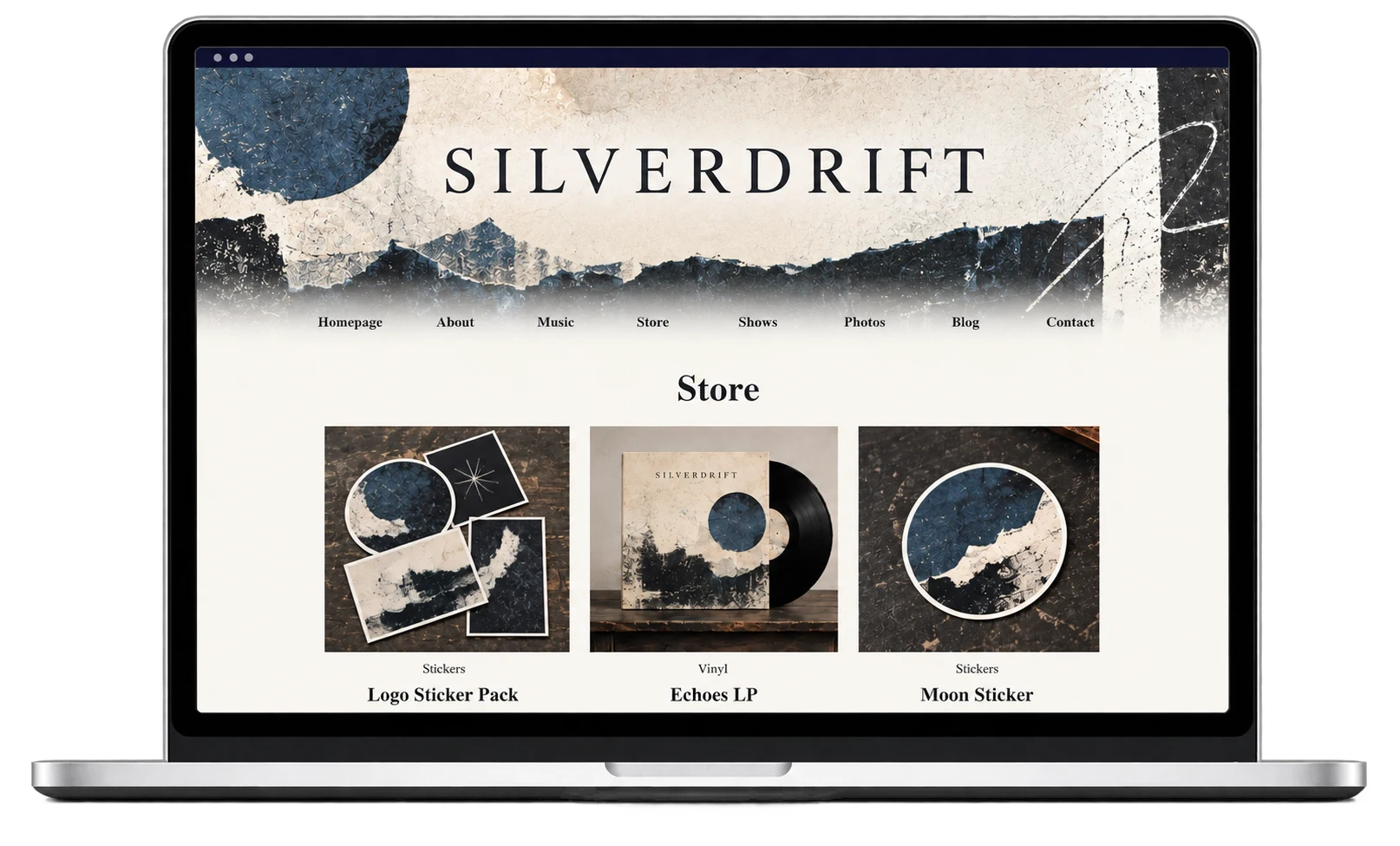
Selling from your own site keeps the buyer's email address with you, and a store with no commission leaves you the price minus card fees. In Noiseyard's store, a record is a Vinyl product with its price, the number you have in stock and a link to its release page. You set a shipping price for each country you post to.
Posting records needs proper mailers and the right postage, and the guide to shipping band merch covers both. When the boxes arrive, tell your mailing list before you announce the record on social media. The band newsletter examples include a short email written for that day.
Your own website gives the record one address to share from shows, emails and posts. The store, the music and your mailing list all sit in the same place.
Build your own musician website
Music player, store, EPK, and mailing list, all built in. Start your 30-day free trial, cancel anytime.
Comparing totals without checking what's included. One quote has test pressings and freight in it, and another leaves them out.
Pressing more than you can sell. Extra copies cost little each, and unsold boxes still tie up money and space.
Announcing a ship date too early. Wait for the plant's date and for your approval of the test pressings.
Sending your streaming master. Ask for a vinyl master, and check your side lengths before mastering starts.
Pre-selling the whole run. Some plants count an order as complete with up to 10% fewer records than you ordered.
Leaving freight and postage out of the budget. Records are heavy on the way to you and on the way to fans.
Trusting a fan-funded service without checking it. Make sure it's still delivering records before you send fans to a campaign.
Is it worth pressing vinyl as an independent artist?
It's worth it when you can sell enough copies to cover the bill. In the example above, that's about 91 records at $25 from a run of 300. If you can't see that many sales yet, start with lathe cuts or an on-demand service and see who buys.
What's the minimum order for vinyl records?
Pressing plants usually start at 100 records, and some budget packages start at 50. Lathe-cut services can make a single copy, and on-demand services have no minimum.
How long does it take to press vinyl?
National Audio Company quotes six to eight weeks as its standard turnaround, and paid rush options shorten that. Add time for mastering and artwork, and check whether a plant's estimate includes the test pressing stage.
Do I need a separate master for vinyl?
Yes, ask for one. Plants such as Gotta Groove recommend audio mastered for vinyl, sent as 24-bit WAV files. Your engineer also needs your side lengths, because long sides have to be cut quieter.
Can I press a cover song on vinyl?
Yes, with a mechanical license for the copies you make, the same as for a CD or a download. The guide to releasing a cover song legally explains what you need where you live.
Do I need a website to sell my records?
You can start without one by selling at shows and on Bandcamp. A website gives the record a page you control, where fans can listen, buy it and join your mailing list.
Get our new guides by email.
Practical advice on promoting your music, getting gigs and selling online. You can unsubscribe at any time.