Photo by Zulfugar Karimov on Unsplash


If you're ordering CDs to sell at shows and online, the quotes can be hard to compare. One quote is for burned discs and another for pressed ones, and each maker prices packaging, printing and turnaround differently.
The prices below come from the lists CD makers publish for runs of 100 to 1,000, along with what each price includes.
Expect about $2 a CD for 100 in jewel cases with a printed insert, before shipping. At 1,000 copies, one US maker charges 89 cents a CD for a 12-day turnaround, with the disc printed in two colors.
Runs under 500 are usually burned onto CD-Rs, which play in all but a few very old CD players. From 500 copies, ask for both burned and pressed quotes.
Packaging changes the price: one maker charges $447 for 300 CDs in slim cases and $690 in four-panel digipaks, which include clear wrap and a two-color disc.
Burned runs usually take one to two weeks and pressed runs two to four at Superdups, counted from when your files are approved. Kunaki's on-demand copies take one business day, plus shipping.
Add shipping to the budget, plus a barcode if a shop will sell the CD and a license for any cover songs.
Sell them at shows and from a store on your own website, where every order comes with the buyer's email address.
A run of 100 CDs in jewel cases with a printed insert costs $209 to $220 on the price lists of two US makers, before shipping. Superdups charges $890 for 1,000, with the disc printed in two colors. An on-demand maker such as Kunaki has no setup fee or minimum order, so it suits small batches.
The two-panel insert in those prices is a single card printed on both sides. Superdups lists higher prices for a booklet, a digipak, a full-color disc or a rush order.
Burning is the usual method for runs under 500, and pressing becomes the cheaper choice somewhere above that. Each maker puts the line in a different place. Ask for both kinds of quote on a run of 500 or more.
Duplication means burning. Your audio is copied onto blank recordable discs, called CD-Rs, and the artwork is printed straight onto each disc.
Replication means pressing. A laser copies your audio onto a glass disc called a glass master. The plant makes metal stampers from it and molds each CD from melted plastic. That setup adds cost and time to a first pressing, which is why pressing only costs less per disc on bigger runs.
Bison Disc recommends burning for orders under 1,000 and pressing above that. If you pick a rush schedule of five days or less, it burns the CDs whatever the size of the order.
A burned CD usually sounds and plays the same as a pressed one when good blank discs and burners are used, Superdups says. The exception is a very small share of CD players that are too old to read a CD-R. Superdups also recommends pressed discs for releases aimed mainly at record stores.
Superdups keeps the stamper on file for reorders. It says a stamper usually fits only the equipment of the plant that made it, which ties your reorders to that maker.
Kunaki works on demand: it burns each order as it comes in, from a single copy, with no setup fee, which suits test runs.
The price per CD stays the same at any quantity. Kunaki deletes a CD from its system after 180 days without a sale, and ordering one copy within that time keeps it on file.
Kunaki and Superdups both publish jewel-case prices that include a two-panel insert. The figures below are from November 2026 and leave out shipping.
| Copies | Kunaki (full-color disc) | Superdups (basic disc) | Superdups (full-color disc) |
|---|---|---|---|
| 100 | $220 | $209 | $249 |
| 300 | $660 | $567 | $687 |
| 500 | $1,100 | $790 | $980 |
| 1,000 | $2,200 | $890 | $1,080 |
Superdups' basic disc has black text under 500 copies and two colors from 500. With full-color discs at both, Kunaki costs less at 100 and 300, and Superdups costs less from 500.
Every Kunaki CD in a jewel case costs $2.20, including full-color printing on the disc, a tray card and clear wrap. The tray card is the printed card at the back of the case, with narrow strips along its edges called spines.
Under 500 copies, Superdups' prices are for its Quick Release package. It has black text on the disc, a full-color insert and a black tray, and lists no tray card or wrap. A full-color disc adds 40 cents a CD.
From 500, its Standard package adds a two-color disc, a tray card, clear wrap and a free barcode on request. The insert is printed in full color on one side and black on the other. The full-color column from 500 is its Deluxe package, which prints the insert in full color on both sides.
These prices are for a 7-day turnaround under 500 copies and a 12-day turnaround from 500, and faster turnarounds cost more. Superdups quotes pressing on request, so ask which method a 500 or 1,000 quote uses.
Bigger runs cost less per CD at Superdups: $2.09 each for 100 and $1.89 each for 300.
Delta Media lists 1,000 pressed CDs in slim cases at 71 cents each with black text on the disc, or 75 cents in full color. The price includes the glass master, disc printing, assembly and wrap, and the package doesn't list a printed insert.
If you're in the UK, Pure Music makes pressed CDs from 100 copies and lists its extras before VAT, such as £20 plus VAT for a barcode. Elsewhere in Europe, ask a maker near you for a quote.
At Superdups, 300 CDs cost $447 in slim cases and $690 in four-panel digipaks, with jewel cases and cardboard sleeves in between.
A jewel case is the standard plastic case, with a tray for the disc and room for an insert or a booklet. A slim case is a thinner version. Cardboard packaging comes as a sleeve, a wallet or a digipak.
A sleeve, also called a jacket, is a printed cardboard pocket for the disc. A wallet folds out to four or six panels, and a digipak is a folding cardboard case with a plastic tray.

Here's what 300 CDs cost in four Superdups packages:
| Packaging | 300 CDs | Disc print and extras |
|---|---|---|
| Slim case, two-panel insert | $447 | Black text |
| Cardboard sleeve | $495 | Black text |
| Jewel case, two-panel insert | $567 | Black text |
| Four-panel digipak | $690 | Two colors, clear wrap |
The first three are Quick Release packages for orders under 500, and the slim and jewel case prices are for a 7-day turnaround. The digipak is priced at a 12-day turnaround, and its listed prices start at 200 copies, with 100 priced on request. A few extras, priced for 300 CDs unless noted:
An eight-page booklet in a jewel case: $747, or $180 more than the two-panel insert.
A six-panel digipak: $890, or $200 more than the four-panel one.
Clear wrap on cardboard sleeves: 20 cents a CD at both Superdups and Bison Disc.
Bison Disc sells 100 CDs in cardboard sleeves for $199, with a full-color disc, its slowest turnaround and no wrap. The same 100 CDs in Superdups' sleeves cost $244, with black text on the disc.
Booklets aren't available at Kunaki, whose jewel cases only take a two-panel insert. Cardboard sleeves are lighter to mail than jewel cases, which Bison Disc gives as one reason to choose them.
Shipping: ask for an estimate before you order. Superdups adds UPS Ground shipping to your bill. Kunaki ships free by UPS Ground on orders of $400 or more to one address in the 48 contiguous states.
A deposit: expect to pay at least 60% when you order at Superdups and the rest before it ships, and 100% upfront for a rush order.
Artwork help: Superdups' prices assume press-ready files on its templates, and it charges $42.50 to check other files and move the art onto its template. Bison Disc's fee is $49 to help fit your art and $295 to design it for you.
A barcode: GS1 US licenses a single barcode, registered to you, for $30 with no yearly fee. One costs $20 at Superdups, or nothing on request with some packages, and $22 at Bison Disc.
A license for each cover song: Superdups won't accept a master with previously published songs unless the proper license comes with it.
Get our new guides by email
Your mastering engineer can deliver the CD master as a DDP image, a folder of files made from the finished album. Pure Music says it's now the format professional mastering engineers prefer for CDs. Mastering prices are in the recording cost guide.
Kunaki converts uploaded WAV or MP3 files and adds a two-second gap between tracks. To keep your own gaps, make an ISO copy of your finished master CD with Kunaki's PC software and upload that. Check the running time with the maker. Superdups recommends up to 74 minutes 20 seconds for a pressed CD and 79 minutes 30 seconds for a burned one.
Settle track titles, the gaps between tracks and the barcode before mastering. Titles can be stored on the disc as CD-Text, which can show on CD players and older car stereos. Devices with an internet connection, such as computers and newer cars, can look titles up in Gracenote's database, and Bison Disc registers a CD there for $28. If your songs have ISRCs, the codes that identify each recording, your engineer can put them in the DDP image.
Give your designer the maker's templates at the start, since specs differ by maker. Superdups wants images in CMYK, the color setting used for print, at 300 DPI or more for the insert and other printed parts. Add an eighth of an inch of bleed, extra background past the cut line, and keep text at least an eighth of an inch inside the cut. Kunaki wants RGB JPG files at 300 DPI and no bleed.
Print your website address on the insert or the back of the case, next to the track list, credits and contact details.
Read every proof before you approve it. Superdups usually has reference samples ready within two business days of your order and files, as a low-resolution PDF or laser prints. Kunaki shows the disc and case in 3-D and lets you play the audio first. It also recommends testing a review copy before a large order.
On demand: Kunaki makes and ships 90% of orders within 24 hours when they're placed before noon Pacific time, not counting delivery. It suggests uploading at least a week before you need the CDs, so a review copy can reach you first.
Burned: one to two weeks at Superdups for duplication orders, which are usually up to 500 copies. Bison Disc's economy option ships in about 10 to 12 business days.
Pressed: two to four weeks at Superdups, which gives two to three as its average. Delta Media quotes three to seven business days for its pressed slim-case package.
Superdups and Bison Disc start the clock when your master and artwork are approved, and Superdups also waits for your deposit. Rush orders cost extra. At Bison Disc, 5-day production adds 85 cents a CD and next-day adds $1.82.
Superdups only promises a ship date if you pay for its date guarantee or a rush. Otherwise, book a release show a couple of weeks after the maker's estimate, and use the same cushion for the date you give pre-order buyers.
Start with your shows. Five CDs a night across 30 booked shows comes to about 150. Then add your previous release's online sales, from your website and other stores, plus some copies for radio and reviewers.
Burned CDs can be reordered within a couple of weeks, so start with a run you're sure to sell.

Superdups' terms let a delivery run 10% above or below your order, and you pay for what's delivered. An order of 500 can arrive as 450 or as 550, so pre-sell no more than 90%.
A made-up band prices 300 CDs in jewel cases with a two-panel insert and a full-color disc. They'll sell them at shows, where a barcode isn't needed.
Superdups: $687 before shipping, or $2.29 a CD, which is $567 for the CDs plus $120 for the full-color disc, with no tray card or wrap listed.
Kunaki: $660, or $2.20 a CD, with free ground shipping to one address in the 48 contiguous states.
At $10 a CD, 66 sales at shows pay for the Kunaki order and 69 pay for the Superdups one, before card fees and Superdups' shipping. That price sits inside the $8 to $15 range in the pricing guide.
If the band could sell 500, the full-color Deluxe package would bring the cost down to $1.96 a CD.
Put CDs on the merch table at every show, and take cards as well as cash. The merch table guide names three card readers and suggests a test payment at home before the show.
For buyers who don't have a CD player, put a download card in the case, with a code they redeem on your website. The download codes guide lists what to print on it.
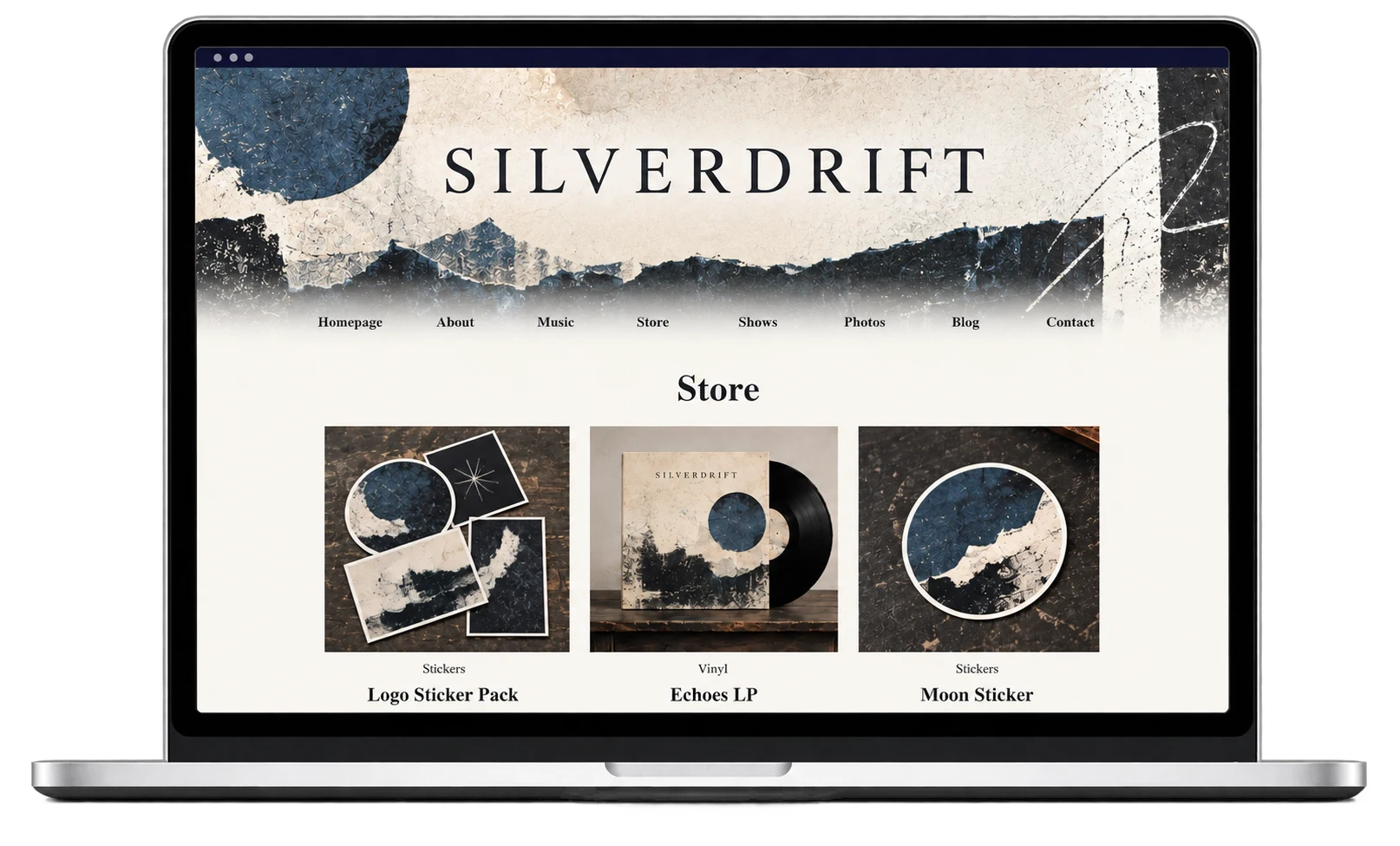
On your own website, the CD can sit in a store next to your music. List the CD in Noiseyard's store with how many copies you have, link it to the album on your discography page and price shipping by country. The store comes with the Standard and Unlimited plans, takes no commission and shows you each buyer's email address with the order.
Before you mail the first order, the shipping guide walks through what a parcel costs, from the mailer to the postage. If you take orders before the boxes arrive, list the CD with its ship date, as the album pre-order guide explains. Kunaki can also mail single CDs to your buyers for you.
Your own website keeps the CD's page up between shows, so people who missed the merch table can still buy it.
Build your own musician website
Music player, store, EPK, and mailing list, all built in. Start your 30-day free trial, cancel anytime.
Taking a low per-CD price at face value. Delta Media's package at 71 cents a CD lists no printed insert, so add the cost of one before you compare it with a quote that includes an insert.
Putting color fades on a screen-printed disc. Two-color discs such as Superdups' Standard ones are screen-printed, and the maker advises against fades there because they tend to print as visible stripes.
Planning the release to the day. Superdups says its turnaround can come in a week early or late, and later in very rare cases.
Waiving the proof to save time. Superdups' terms say it isn't liable for misspellings or other print errors on a job whose proofs you waived.
Yes, if you play shows where people buy merch, since a 300-CD run from Kunaki is paid off after 66 sales at $10. US CD sales are falling, and the RIAA's year-end report counts 29.5 million CDs shipped in 2025 after returns, down 11.6% from 2024.
You can order a single copy from an on-demand maker such as Kunaki. Bison Disc takes orders from 25 discs. Pressed CDs start at higher quantities, such as 100 at Duplication.com in Toronto and 1,000 for Delta Media's slim-case package.
Get one if a shop or distributor will sell the CD. Shops use the barcode to identify the CD, and distributors use it to track sales. You can leave it off for sales at shows and from your own store.
In the US, yes, once a recording of the song has been released there, as long as your version keeps its basic melody and fundamental character. Each cover needs a mechanical license, with a royalty for every CD you make and distribute at a rate the Copyright Royalty Board sets. Other countries set their own rules, and the guide to releasing a cover song legally has a section on where they differ.
Make CDs when you want copies that cost about $2 each and arrive within a few weeks. Superdups lists 300 jewel-case CDs with a black-text disc at $567, and the vinyl pressing cost guide found about $2,000 to $2,300 for 300 records.
No, you can sell them at shows without one. A website helps when people ask after the show where to buy the CD, since you can give them one link. Other reasons to have one are in why every musician, band or DJ needs a website.
Get our new guides by email.
Practical advice on promoting your music, getting gigs and selling online. You can unsubscribe at any time.