Photo by Apo Stock on Unsplash


Studio prices are hard to compare. One studio charges by the hour and another by the day, and the engineer, mixing and mastering might be in the price or billed separately.
If you're an independent musician planning a recording, from a single at home to an album in a studio, here's what each part costs. The prices come from studios and engineers that publish them, and the example budgets near the end add them up.
Studio time with an engineer costs $50 to $150 an hour at three US studios. Two US studios that offer day rates charge $775 to $1,100 a day.
Mixing is usually priced per song. The median was $162.50 a song in 313 indie, punk or folk mixing listings on two online marketplaces, and $200 among US engineers.
Mastering costs $80 to $125 for a single at two studios that list their prices, and $70 to $85 a song for an EP or album.
For a rehearsed band booking three studio days, a 5-song EP recorded, mixed and mastered comes to about $3,200 to $5,300. Recorded at home, it's about $1,000 to $2,200 if you already own a microphone and headphones.
Before you book, finish the arrangements, ask for an itemized quote, and make sure the agreement says you get the session files.
A 10-song album recorded in five studio days, mixed and mastered, comes to about $5,600 to $9,400 at the prices below. That's five days with an engineer at $775 to $1,100 each, mixing at $100 to $300 a song and mastering at $70 to $85 a song. Recording at home cuts the cost of the studio days.
A recording bill has a few separate parts. Some studios bundle them into one rate, and others list each one on its own:
Studio time. The room and its equipment, by the hour or by the day.
An engineer. The person who sets up the microphones, gets the sounds and runs the session. Often included in the studio's rate.
A producer. Optional. Someone who helps shape the songs and the performances.
Session players. Optional. Musicians you hire for parts the band doesn't play.
Editing. Tightening timing and tuning after the takes.
Mixing. Balancing every recorded part into one finished stereo track per song.
Mastering. The final pass that evens out level and tone across the songs and makes the files for release.
Smaller items add up too: tape if you record to it, drum or instrument rental, piano tuning, and somewhere to stay if the studio is out of town.
Here's what four US studios listed on their own sites or booking pages in November 2026 for a session with their engineer:
| Studio | City | Rate with an engineer |
|---|---|---|
| Loud and Strong Music | Sarasota | $50 to $60 an hour |
| Different Fur | San Francisco | $90 to $150 an hour |
| Welcome to 1979 | Nashville | $150 an hour, 3-hour minimum |
| Electrical Audio | Chicago | $775 to $975 a day |
At Electrical Audio, that's $550 or $750 a day for the room plus $225 for a staff engineer. In the UK, an 8-hour day with an engineer at Chem19 costs £220 to £385 plus VAT. Urchin Studios in East London rents out its tracking room for £500 a day plus VAT, with engineers extra.
Longer bookings cost less per hour at three of these studios. A 12-hour day at Welcome to 1979 costs $1,100, about $92 an hour, compared with $150 when you book by the hour. Loud and Strong drops from $60 to $50 an hour in 6- and 12-hour blocks. At Different Fur, Studio A is $150 an hour for up to 3 hours and $100 an hour for 8 hours or more. Electrical Audio charges by the day so you don't have to watch the clock, and it books half-days for overdubs, mixing or a small group without drums.
Rock bands should probably book at least a full day, Electrical Audio says, because miking up a band and getting sounds "is usually a half-day affair in itself". Don't try to fit too many songs into the days you book. In a 2013 Performer Magazine piece, two producers at a Massachusetts studio walked through a plan for six songs in two days. It left about half an hour to mix each song, which they called "barely enough time to get a rough mix going".
Get our new guides by email
Mixing engineers usually quote per song. Across 313 public mixing listings on AirGigs and SoundBetter, half the engineers asked between $100 and $300 a song, and the median was $162.50. US engineers among them had a median of $200. Those figures come from a study of the listings by Denmark's Tapetown Studio in October 2026, covering engineers who list genres like indie, alternative, punk or folk.
These are asking prices on two marketplaces, and many engineers with long credit lists only quote on request, so the study doesn't include them. Before you compare quotes, ask what each one covers:
How many rounds of changes are included.
Whether mastering is part of the price, as it was in 31% of those listings.
Whether alternate versions, like an instrumental or a clean edit, cost extra.
Which files you get back, and how long the engineer keeps your sessions.

Some studios charge for mixing by studio time. Electrical Audio suggests a half-day to cover "a song (or maybe two?)". Whoever you hire, listen to records they've mixed in your genre, and try one song with them before you book the rest.
Mastering is priced per song too, and both studios below charge less per song for an EP or album than for a single:
Chicago Mastering Service: $70 to $85 a song for an EP or album, and $80 to $115 for a single, depending on the engineer. Up to five rounds of revisions are included.
Welcome to 1979 in Nashville: $85 a song when you master several, and $125 for one song. A master for digital distribution and streaming costs $75 on projects of five songs or more.
Alternate versions cost extra: $40 a song at Chicago Mastering Service and $25 at Welcome to 1979. If you're also pressing vinyl, ask for a separate vinyl master, which costs $90 at Chicago Mastering Service.
Ask whether the engineer will master a test song first. For projects of three or more songs, Chicago Mastering Service starts with two songs and bills half of the project's mastering cost. If they can't get those two right for you, you don't owe anything.
Automated mastering runs your mix through software, without an engineer listening to it. Some services have a free option, and others charge per track or by subscription.
Producers help with arrangements, parts and performances, and some bring in extra musicians.
A producer can be paid one all-in fee, or a fee plus a royalty called points, according to a producer agreement fact sheet from Australia's Arts Law Centre. A point generally means 1% of the royalty base the artist is paid on. With points, the fact sheet says at least part of the fee should be recoupable, so the producer's first royalties go toward paying it back.
Put the deal in writing before the first session. Make sure it says the producer hands over the multitrack sessions along with the finished mixes, because without them you can't remix or fix the songs later. If the producer co-writes a song, agree on the songwriting split up front.
Ask session players for a price per song or per session that includes the files you need, and agree on who hires and pays them. Their fees can be a separate line in your budget or part of an all-in producer fee. UK session musicians have minimum fees for recording, so check the current ones before you budget. A new BPI and Musicians' Union agreement raised them by 40% for pop and 15% for classical from January 1, 2026.
To record yourself, you need an audio interface, a microphone, headphones and recording software. Focusrite's US store lists its Scarlett Solo interface at $169.99, and it comes with three recording programs: Pro Tools Intro+, Ableton Live Lite and Cubase LE. REAPER is another choice. Its discounted license costs $60 for personal use, or for commercial use if your yearly gross revenue is $20,000 or less.

If your songs need live drums or the whole band playing at once, that's the part to spend studio money on. Track those parts in a studio and record vocals and overdubs at home, where you can do as many takes as you need.
These budgets add up the prices above for a rehearsed band that tracks two songs a day, with vocals and overdubs in the same days. They use $775 to $1,100 a studio day and $100 to $300 a song for mixing. Mastering is $80 to $125 for a single, and $70 to $85 a song for an EP or album. For the EP and album, the top end includes Welcome to 1979's $75 master for digital distribution and streaming.
| Project | Recording | Mixing and mastering | Total |
|---|---|---|---|
| Single, 1 studio day | $775 to $1,100 | $180 to $425 | $955 to $1,525 |
| 5-song EP, 3 studio days | $2,325 to $3,300 | $850 to $2,000 | $3,175 to $5,300 |
| 10-song album, 5 studio days | $3,875 to $5,500 | $1,700 to $3,925 | $5,575 to $9,425 |
| 5-song EP recorded at home | $170 interface | $850 to $2,000 | $1,020 to $2,170 |
Each extra studio day adds $775 to $1,100. A producer, session players and extras such as tape or instrument rental come on top. The home row also leaves out a microphone and headphones, which you may already own. If you haven't settled on a single, an EP or an album yet, decide that first, because it sets the number of studio days.
Finish the songs before you book. Lock the arrangements, tempos and keys, and rehearse until the band can play each song start to finish. A rough demo of every song shows what's missing before you pay for studio time.
Track the band playing together. Ask the engineer how many songs a day your band can get through that way.
Record fewer songs, finished properly. Put the money into your strongest songs if it runs short, and record the rest at the next session. The Performer Magazine writers, who also worked at a music publishing company, said they paid attention to artists who had one amazing song.
Ask for an itemized quote. Room, engineer, extras, mixing rounds and mastering should each have their own line, so you can compare two studios item by item.
The studio, mixing and mastering bills all arrive before the music earns anything, and releasing it adds the cost of distribution and artwork. Running a pre-order helps cover those bills, because fans pay now and get the music on release day.
After release, selling your music and merch online can earn back some of the recording cost over time. Email your fans before you post anywhere else, and if you don't have their addresses yet, start building an email list before release day.
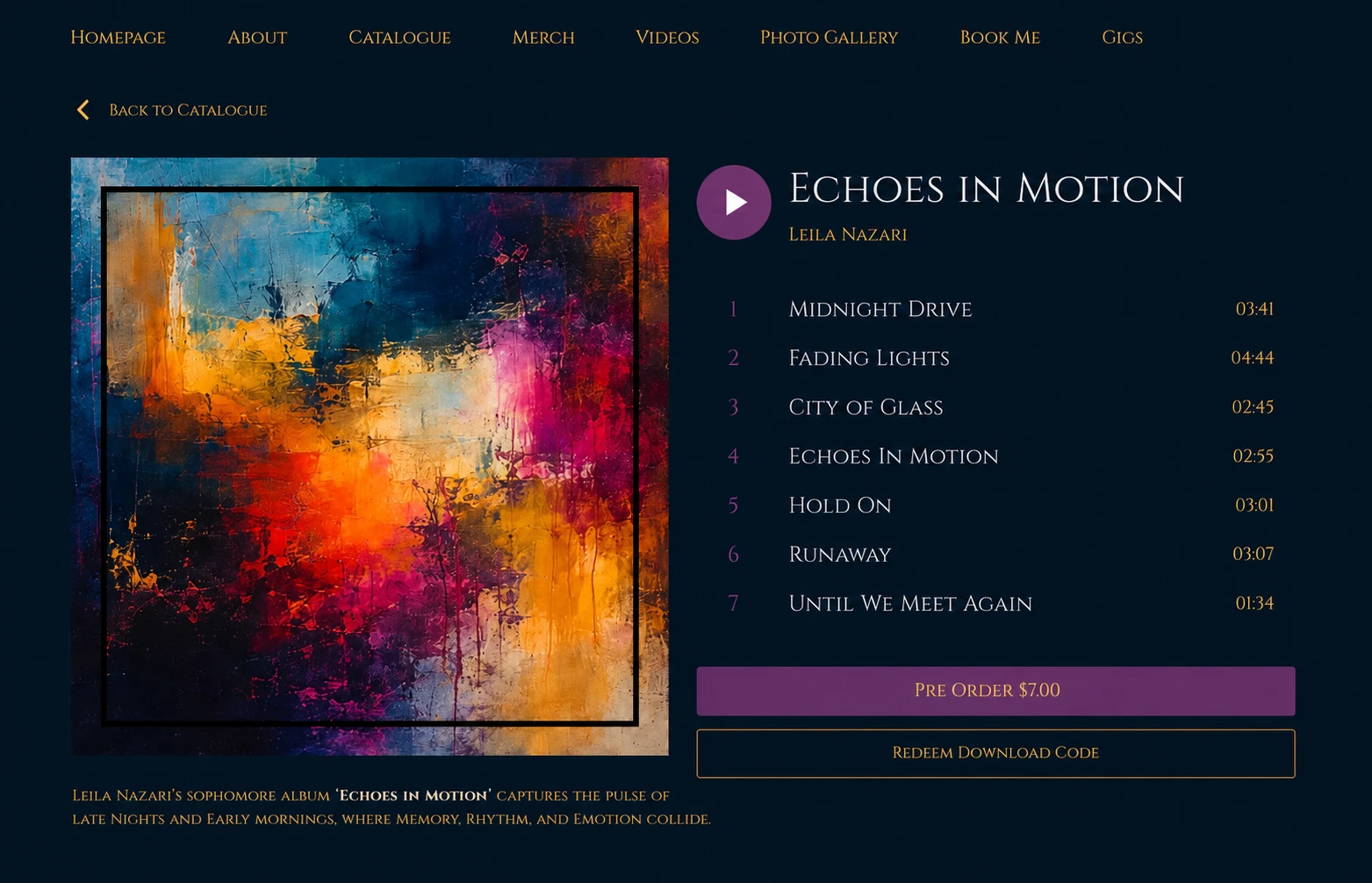
A pre-order page and a store on your own website keep the payment and the buyer's email address with you. On Noiseyard's Standard and Unlimited plans, you can run album pre-orders and sell music and merch with no commission.
Build your own musician website
Music player, store, EPK, and mailing list, all built in. Start your 30-day free trial, cancel anytime.
It's $50 to $150 an hour with an engineer at the three US studios in this guide that charge by the hour. A longer booking brings it down to about $50 to $100 an hour at each of them.
For one song, expect about $180 to $425. That's mixing at $100 to $300, the middle half of the 313 listings above, plus mastering a single at $80 to $125. Some engineers sell mixing and mastering together, so check what the price includes.
In cash, yes. An interface that comes with recording software costs about $170, and you'll also need a microphone and headphones. A day with an engineer costs $775 to $1,100 at the Chicago and Nashville studios above. It takes more of your own time, and parts like live drums may still need a studio day.
No. You can hire a studio and its engineer to record, mix and master without one. The UK studio Chem19, for example, charges extra for production. A producer is worth paying for when you want someone to shape the songs with you.
Count the songs that are finished and rehearsed, and price them with the budget table above. Then send the same song list to two or three studios, so their quotes cover the same work.
Get our new guides by email.
Practical advice on promoting your music, getting gigs and selling online. You can unsubscribe at any time.