Photo by Diane Picchiottino on Unsplash


Once a venue books you, the people running the show need details from you. The sound engineer wants to know how many microphones to set up, and the promoter wants to know how many people to feed. Your rider answers those questions before you arrive, so nobody has to work them out on show day.
This guide is for bands, solo artists and DJs writing their first rider. You'll find templates you can copy for the tech rider and the hospitality rider.
A rider usually has two parts: a tech rider for what happens on stage, and a hospitality rider for food, drinks, a dressing room and your guest list.
For a club show, keep the tech rider to one page and the hospitality rider shorter. Send the tech rider as soon as the show is confirmed.
Check your rider against the venue's equipment list. Well before the show, sort out anything the venue can't supply.
Before you add extras to your hospitality rider, ask the promoter whether you'll pay for them out of your fee.
On bills with several bands, you'll often share the drum kit and amps. At a festival, send what it asks for, such as a stage plot and input list, by its deadline.
Put a summary of your tech rider on the press kit page of your own website, and update it whenever your setup changes.
A tech rider tells a venue what you need to put on your show. It lists your lineup, the gear you bring, the gear and sound system you need from the venue, and who to call with questions. It's usually attached to your performance contract. The other part of a rider, the hospitality rider, covers food, drinks and guests.
The tech rider is read by the people setting up your show: the venue's production manager and its sound and lighting engineers. You'll also see it called a technical rider, a production rider or a tech spec. Venues use "spec" for their own equipment list too.
Here's what to send for four common kinds of show:
| Show | Tech side | Hospitality side |
|---|---|---|
| Bar or café, with your own PA | A few lines: lineup, setup time, power | Usually not needed |
| Club with a house engineer | Tech rider, stage plot and input list | A short list |
| Opening slot on a shared bill | A short rider, checked against the shared gear | Ask the promoter |
| Festival | Whatever the festival asks for, by its deadline | Take what the festival offers |
When you're starting out, you can usually expect basics like towels and drinks without a hospitality rider, according to a guide from the UK music school Leeds Conservatoire. If you're still looking for your first shows, start with how to get gigs as a musician.
For a club show, aim for one page of short bullet points, and keep the detail simple. Include these parts:
Contacts. Your production contact, the person who handles questions about sound and gear, plus someone the venue can call on the day of the show. Give phone numbers for both.
Lineup. Each person's name and what they play or sing, so the crew can learn who's who. Add one line about the show, such as "four-piece rock band, 45-minute set."
Stage plot and input list. A drawing of where everyone stands, and a numbered list of every microphone and instrument that goes into the mixing board. Our guide to making a stage plot and input list walks through both.
Your gear and the venue's gear. List the backline you bring, meaning the amps, drums and keyboards you play on stage. Then list what you need from the venue. Some venues have drums and amps, some don't, and some can rent them for a fee.
Monitors. These are the speakers on stage that let you hear yourselves. Say how many monitor mixes you need, and who needs to hear what in each. If you use in-ear monitors, note that and say what mix they need from the sound engineer.
Stands, DI boxes and power. How many mic, keyboard and guitar stands you need, which instruments go straight into the board through a DI box, and where you need power on stage.
Times. When you can load in, how long your soundcheck takes, how long you play, and how long you need for changeover, the time between acts.
If you're a small band without much gear, your rider will mostly list what you use on stage. As you grow, you can add your own mixing board or lighting to it. A solo act's rider can be a few lines: one vocal mic, a DI for your guitar (two for stereo keys), one monitor mix and your phone number.
Copy this into a document, swap in your own details and delete any line you don't need. The example is filled in for a four-piece band whose singer also plays keys, the same setup as in our stage plot guide.
Act: [band name], four-piece rock band, 45-minute set
Updated: [date]
Production contact: [name, phone, email]
Day-of-show contact: [name, phone]
Lineup: [name], lead vocal and keys. [name], guitar and backing vocal. [name], bass. [name], drums.
Stage plot and input list: attached, 12 inputs
We bring: guitar and amp, bass and amp, keyboard and stand, drum kit, guitar pedalboard, all instrument cables
We need from the venue: PA, 9 mics (2 vocal, 6 drum, 1 guitar amp) and 3 DI channels (bass, keys left, keys right). XLR cables, and stands or clips for every mic.
Monitors: 4 mixes. Singer (keys): lead vocal, keys and guitar. Guitarist: both vocals. Bassist: lead vocal and guitar. Drummer: lead vocal, guitar and bass.
Power: 4 locations, for the bass amp, the guitar amp, the pedalboard and the keyboard
Times: load-in from [time], [number]-minute soundcheck, [number]-minute changeover
Priorities: [the few items you can't play without]
Notes: [anything else, such as a left-handed drummer or backing tracks from a laptop]
Get our new guides by email
Email the tech rider as a PDF once the show is confirmed, well before the date. That gives the venue time to sort out anything it doesn't have.
The venue will usually reply with its own spec, a list of the equipment it has, and flag any concerns about your requests. Some venues post their spec online. The 40 Watt Club in Athens, Georgia, lists its stage size, two mixing consoles, monitor speakers, microphones, stands and DI boxes. Look for your venue's spec before you email your rider.
Go through your rider line by line, checking off each item the venue's spec covers. Ask about anything it leaves out, and say what you'll bring for items the venue can't supply. If something has to be rented, agree early on who pays for it.
A week or two before the show, check in with the venue to make sure it got your rider, and confirm the setup, your load-in time and your set length. Bring printed copies of both riders to the show.
On a night with several bands, the drum kit and amps are often shared to save time between sets. At minimum, the opening acts share them, and sometimes every band on the bill does. Drummers bring their own "breakables", such as a snare, cymbals and a kick pedal. Guitarists and bassists may only need their instruments, amp heads and pedals.
Ask the promoter who's providing the shared gear and what's in it, and compare that with what you need. Say early if your drummer plays left-handed, because switching the drum kit around takes extra time at changeover.
Festivals may have their own forms and deadlines. FoCoMX is a festival in Fort Collins, Colorado. For its 2026 edition, held on April 24 and 25, it asked every act to upload a stage plot and input list by April 13.
Its artist page explained that many of its venues were regular businesses with a PA brought in for the festival. So FoCoMX couldn't guarantee acts the gear they were used to, or fulfill rider requests. It also couldn't accommodate in-ear monitor rigs. Where a drum kit was provided, acts were asked to use it and bring their own snare and cymbals.
Make a shorter version of your rider for these shows, with your lineup, input list and the gear you'll bring. To find festivals and apply to them, read how to get booked at music festivals.
A DJ rider is mostly about the booth. Name the exact players and mixer you play on, and how many of each, the way Pioneer DJ's own sample riders for its common booth setups list them. Several of its CDJ-3000X sheets also ask for the CDJs and the mixer to run the latest firmware, and for the gear to be linked through a network switch.

If you bring a laptop or a controller, say so in the rider. List the cables you need to connect to the venue's mixer, and ask for power in the booth. Joey Santos, managing editor of Digital DJ Tips, wrote that his rider told festivals he'd be bringing his own controller. As a result, they left space for it beside the usual players and mixer.
A club DJ rider can be this short:
Act: [DJ name], [set length]
Players: [number] x [model], linked, on current firmware
Mixer: [model]
Booth monitors: [number]
I bring: [laptop or controller], plus [cables] to the mixer
Power and space: [number] outlets and room for [your gear]
Contact: [name, phone]
For your first club bookings, how to get booked as a DJ has the steps.
The hospitality rider is for what you need off stage. It can include:
Meals for the band and crew, with any dietary needs
Drinks, such as water, soft drinks, tea or coffee, and sometimes alcohol
A dressing room with towels, mirrors and seating
Wi-Fi and outlets for charging
Names for the guest list, such as friends, family or industry guests
Keep the hospitality rider short. Sean McPherson, bassist in the band Heiruspecs, told the radio station The Current in 2015 that his band's rider was about seven lines long. It listed meals, beer, tea, water and vegetables, and it hadn't changed since 2003.

Send the hospitality rider when you send your tech rider, so food and space are taken care of before show day. Before you add extras, check who pays for them. Leeds Conservatoire's guide warns that the cost of specific hospitality requests may come out of your performance fee. Ask too whether the venue or promoter provides a meal or pays a buyout, which is money for food. If it's a buyout, ask how much it is and how many people it covers.
For shows out of town, add somewhere to sleep if the promoter can provide it. You can also ask for water and snacks to take with you for the next day's drive. To budget for food and places to stay on the road, see how to book a DIY tour.
If you'll sell merch, ask for a table and whether the venue takes a cut of sales. Our merch table guide explains the venue cut.
Fill in what applies to your show and delete the rest:
Act and show: [band name], [venue], [date]
People: [number] musicians and [number] crew
Food: a meal for [number] people, or a buyout of [amount] per person. Dietary needs: [details]
Drinks: water on stage, plus [soft drinks, tea, coffee, beer]
Dressing room: towels, a mirror, seating and the Wi-Fi password
Guest list: [number] spots, with names sent by [day]
Out-of-town shows: [number] beds or rooms, and parking for [vehicle]
Merch: a table near [the stage or the door]. Please confirm the venue's cut of sales, if any.
On the press kit page of your website, add a few lines from your tech rider: your lineup, how many inputs and monitor mixes you need, and a production contact. A venue can then check whether it can handle your setup before it books you. Have the full rider ready as a PDF for any venue that asks.
Leave the hospitality rider and anything about money off your website. In the same 2015 article from The Current, concert promoter Patricia McLean said "the unspoken guideline" is that performers' contracts are "highly confidential on all levels". That includes what artists are paid and the food they ask for.
Every Noiseyard plan includes a press kit page where a text section can hold those setup lines, on the same page as your live videos and a contact form. For the rest of the press kit, see what to include in an EPK.
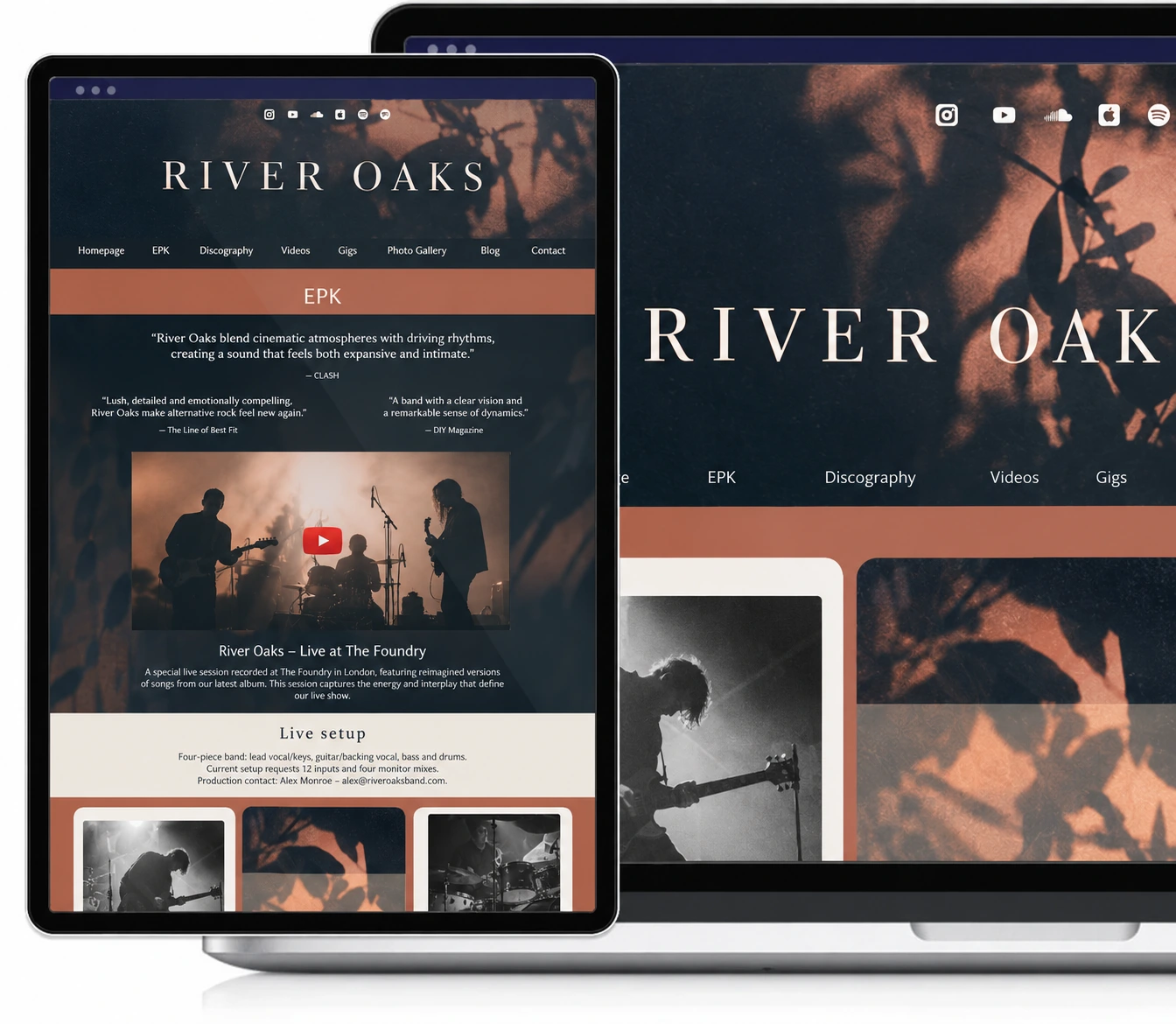
When your lineup or gear changes, update those lines on your own website, so the page always shows your current setup.
Build your own musician website
Music player, store, EPK, and mailing list, all built in. Start your 30-day free trial, cancel anytime.
A rider that doesn't match your input list. If the rider asks for three vocal mics and the input list shows two, the engineer has to guess which is right. Check them against each other before you send them.
Brand names you don't need. For backline and mics, name a specific model only when nothing else will do, so the venue can offer what it has.
No priorities. Mark the few items you can't play without, so the venue knows what it has to find and where it can offer something similar.
Old details. A former member's name or an old phone number on the rider can cause confusion at the show. Put a date on each version, and swap in new names and numbers as soon as they change.
Usually, yes. The main contract covers when and where you play and what you're paid, and the rider spells out what you need to perform. Venues and promoters go through riders when they negotiate the deal, and they can say no to some requests. Keep the version you both agree to in writing.
They can be, and many artists combine them. If you do, keep the layout clear so the technical part doesn't get lost. In a guide from the UK music college WaterBear, production manager Barry McParland recalls a tour whose tech and hospitality riders were one document, run through translation software. The software moved a keyboard from the backline section to the catering section, so nobody arranged it. It was missing at the first show, on a Sunday night in London, and his team had to get a backline company to reopen to supply one.
To check that the promoter had read the rider. Van Halen's 1982 world tour rider listed "M&M's (WARNING: ABSOLUTELY NO BROWN ONES)" in its "Munchies" section, as Snopes' fact check shows. David Lee Roth wrote in his memoir that the band's stage show was so big that mistakes could be dangerous. A brown M&M backstage meant the promoter hadn't read the contract, so Roth would have the whole production checked for errors.
No. Riders usually go out by email as a PDF, so you can send yours without one. A summary on the press kit page of your own website keeps your setup and production contact where a venue that's booked you before can find them.
Write both riders before your next booked show, using the templates above. After the show, add anything the crew had to ask you about, so the next venue gets a clearer version.
Get our new guides by email.
Practical advice on promoting your music, getting gigs and selling online. You can unsubscribe at any time.