Photo by Elizeu Dias on Unsplash


A promoter or booker gives your pitch about thirty seconds before they move on. Your electronic press kit (EPK) is the page that has to win those thirty seconds. Most artists get it wrong in one of two ways: they leave the page half-empty, or they cram in everything they have ever made. Both versions get skimmed and closed.
This guide is for solo artists, bands, and DJs who know they need an EPK and want to know what goes in it. Below are the six sections the people who book and cover music look for first, what each one should say, and the mistakes that get a page ignored.
An EPK needs six things: a short bio, music to play in one click, press quotes, high-resolution photos, live dates, and a clear contact route.
Keep it to one page with a single shareable link. Bookers click, they rarely download.
Write your bio in three lengths (one line, one paragraph, full) so you can reuse it everywhere.
Make your photos high resolution and downloadable, or press will pull a blurry screenshot off your Instagram.
Put a real booking contact at the top and the bottom. Don't make anyone hunt for it.
Leave out anything that doesn't help someone say yes: full discographies, every remix, walls of links.
A strong EPK includes a short bio, a featured track or release to listen to, two or three press quotes, high-resolution press photos, your live dates, and a direct contact for booking. Put it all on one page with one link, written so a stranger gets you in under a minute.
Six sections sounds like a lot, but each one is short. The point isn't to say everything. It's to answer the four questions every booker has: who are you, what do you sound like, can you bring people, and how do I reach you.
Your bio is the first thing a booker reads, so it has to land fast. Write it in the third person and lead with what makes you different, not where you were born. One strong opening line does more than a paragraph of backstory.
Keep three versions on hand: a one-liner for a subject line or social bio, one tight paragraph for the EPK itself, and a longer version for press who want detail. Most pitches only need the short ones. Mention real proof points: a notable release, a support slot, a festival, a stream count if it's strong.
If writing about yourself feels awkward, our guide on how to write an artist bio walks through structure and gives examples you can copy.
A booker wants to hear you before they read another word. Embed one featured track or release right on the page so they can press play without leaving, signing in, or downloading anything.
Pick your most representative song, not always your newest. If your latest single doesn't show your range, lead with the one that does. One great track beats a wall of ten embeds that nobody finishes.

A common mistake is sending a private streaming link that asks for a login, or a Drive folder of music files. Both add friction, and friction is what gets your email closed. The music should start in one tap.
Get our new guides by email
Two or three short quotes do more than a long list. Pull the strongest line from each review, blog feature, or radio play, and add a credit so it reads as real: the line, then the outlet or writer.
No press yet? Use the proof you do have. A quote from a respected local promoter, a notable playlist add, a sold-out hometown show, or a clear stream milestone all count. The job of this section is social proof, and there is more than one way to show it. A dedicated press page on your site can hold the longer list while the EPK shows the highlights.
Keep the quotes scannable. If a layout lets you set them in a stacked list or a grid and reorder them by drag-and-drop, put your best one first.
If you don't give press usable photos, they will grab a low-res screenshot from your socials, and your show listing will look cheap. Include two or three high-resolution shots: a mix of live energy and a clean posed image works for most situations.
Make them downloadable straight from the page, and offer both a landscape and a portrait option so they fit a website banner or a vertical flyer. Credit the photographer if there is one. That single courtesy makes you look like someone who has done this before.

One small detail that pays off later: name the image files with your artist name and add alt text. That helps your EPK show up when someone searches you. (If your website builder handles headings and alt text automatically, you can skip this step. If it doesn't, our SEO guide for musicians covers what to add by hand.)
Bookers are deciding whether you can fill a room. Show them. List your upcoming shows, and if you don't have any booked, list recent ones so the page doesn't look stale.
Where you can, point to proof of draw: a sold-out show, a support slot for a known act, a festival name, or a venue capacity you have played to. Concrete beats vague every time. "Sold out the Lexington, 200 cap" tells a promoter more than "great live energy."
If your EPK lives on your music site, a built-in event calendar keeps these dates current without extra work. For the bigger picture on landing shows in the first place, our guide on how to get gigs as a musician goes deep on pitching venues.
This is the section artists forget, and it's the one that turns interest into a booking. Put a clear contact at the top and the bottom of the page so nobody has to hunt for it.
Use a real route: a booking email, or a contact form that lands in an inbox you check. If you split roles, label them plainly: booking here, press there, management for the rest. A form that sends inquiries straight to your account email saves you from posting your address in public while still making you reachable.

The worst version of this section is a contact buried in a footer, or no contact at all. If someone has read this far, they are ready to reach out. Make the next step obvious.
What you cut matters as much as what you keep. Skip these:
Your full discography. Feature one release, link the rest if you must.
Every social and streaming link. Pick the two that matter.
A life story. Save it for the long bio, not the EPK.
Music that autoplays on load. It makes people scramble for the close button.
A PDF as your only format. Keep a PDF as a backup, but lead with a web page.
If a section doesn't help someone say yes to a booking, a review, or a placement, it's taking up space.
You can assemble all of this by hand, but a music-focused website builder turns it into a fill-in-the-blanks job. The right one gives you a pre-built EPK page with the sections above already laid out: bio, featured release with a working player, press quotes, downloadable photos, and a contact form that routes to your inbox.
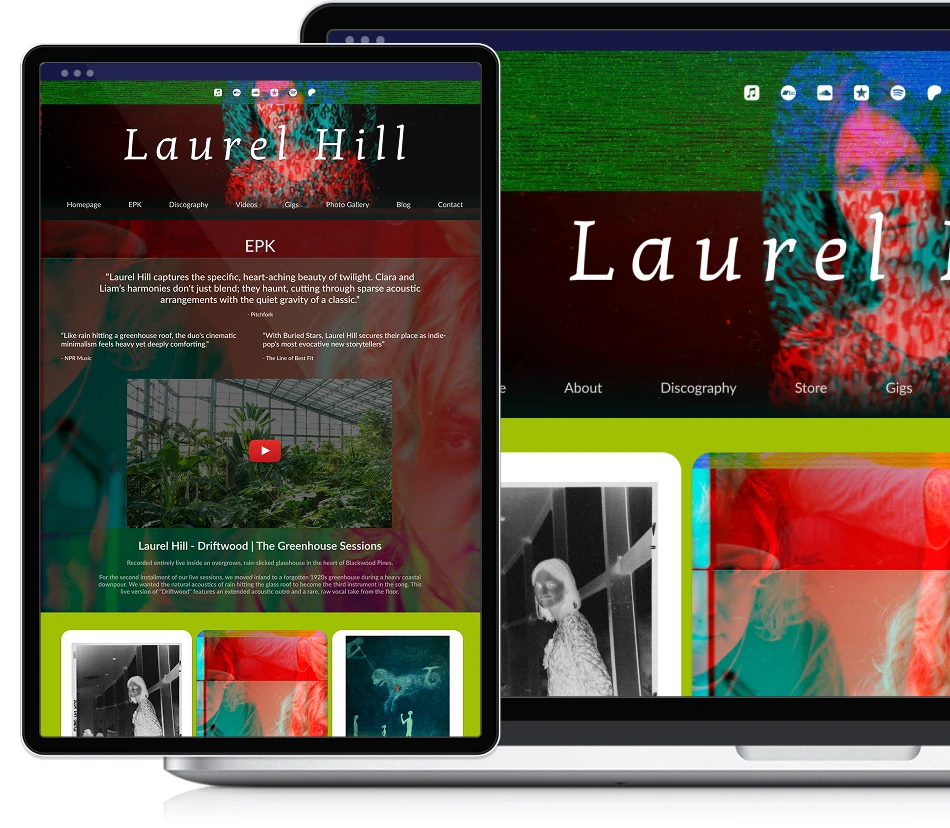
It also quietly handles the technical side, clean headings, alt text, mobile layout, and fast loading, so the page is findable and reads well on a phone without you touching code. On Noiseyard the EPK page is included on every plan and sits on the same site as your music, store, and gigs, so one custom domain covers everything. You can even keep it hidden from your public menu and share it by direct link when you only want certain people to see it.
If you want the full setup walked through step by step, see our guide on how to make an EPK.
Build your own musician website
Music player, store, EPK, and mailing list, all built in. Start your 30-day free trial, cancel anytime.
What's the difference between an EPK and a press kit?
They are the same thing. An EPK is the electronic, online version of a traditional press kit. Today it usually means a single web page you can share with a link, instead of a printed folder or a stack of attachments.
Do I need an EPK if I have no press coverage yet?
Yes. Swap the press quotes for other proof: a local promoter's recommendation, a playlist add, a sold-out small show, or a stream count. The other five sections matter just as much, and they show you take your project seriously.
Should my EPK be a PDF or a web page?
A web page. Bookers click links far more readily than they download files, and a page is easier to keep current. Keep a PDF version as a backup for the rare person who asks for one.
How long should an EPK be?
One page. A booker should be able to scan the whole thing in under a minute. If they want depth, they will click into your bio or your full site. The EPK is the summary, not the archive.
How often should I update it?
Refresh it with every release and tour. The fastest way to look inactive is an EPK with last year's dates and a photo you no longer use. Updating live dates and the featured track takes a few minutes.
Can I keep my EPK private?
Often, yes. Some builders let you hide the page from your site menu while keeping it live at its own link, so you can send it to specific promoters without putting it on your public navigation.
A good EPK isn't about saying more, it's about answering four questions fast: who you are, what you sound like, whether you can draw a crowd, and how to book you. Cover those six sections, keep it to one page, and update your dates before you send it. Do that, and your link earns the reply that a Drive folder never will.
Get our new guides by email.
Practical advice on promoting your music, getting gigs and selling online. You can unsubscribe at any time.

Music Career Advice
How to release music independently: A complete guide for DIY musicians