MARKETING & PROMOTION
How to Make a Rapper Website (and Get Booked)

Deniz

Aug 14, 2026
Someone hears a track, likes it, and searches your name. What they find is a streaming profile, an Instagram, and a link in bio with eleven buttons on it. That works for a fan. A promoter deciding whether to put you on a bill, or a brand working out what to pay you, needs things none of those pages hold.
This post is for rappers and hip hop artists who want a site of their own and want to know what belongs on it. It covers what goes first, how to price a feature verse, what your beat licence lets you sell, and how to make booking you take one email instead of five.
TL;DR
-
Put a video section near the top of the homepage, since people watch rap as much as they listen to it.
-
Put one booking email where it can be found in five seconds, and keep it on every page.
-
List a feature verse as a service with a price, a turnaround, and what the buyer gets, so the "how much" conversation stops living in your DMs.
-
Check your beat licence before you sell a track from your own store. Non-exclusive leases usually cap streams and often split publishing with the producer.
-
Own your name in search, because a lot of rap names are ordinary words and your own domain is what wins that page back.
-
Keep a mailing list, since a limited drop only sells if you can tell people the day it goes up.
Table of contents
Do rappers need a website?
Once you are being booked, pitched, or paid, yes. Streaming profiles and social accounts show the music. They hold no booking contact, no rate, no press photos, no bio, and nowhere to buy. A website is the one link you can send and know it answers all of that.
The four people who look you up
Four people tend to make this worth building, and each one is looking for something different.
-
A promoter with a slot to fill. They want recent music, a live video that proves you can hold a room, a photo they can put on the flyer, and an email that gets answered.
-
A label or manager. They want to see a body of work, not just the song that reached them, and to know whether anything is already committed to someone else.
-
A brand or a music supervisor. They want to know who owns the track. If a beat is leased and the publishing is split, that is a conversation they need to have before they can use it.
-
A journalist or a playlist curator. They want a bio they can quote and a photo that is not a screenshot from a video.
Put a video near the top of the homepage
People watch rap as much as they listen to it. The verse, the delivery, the look and the edit all arrive at once, and a photo only shows you one of them.
So add a video section to the homepage and move it as high as your template allows. Use a music video if you have one, a live clip if the room was full, or a studio take if that is all you have. Some templates put a site header above it, so aim for the video to be the first thing underneath. Keep a separate video page for everything else, so the homepage only needs one.
Put the freestyles and vertical clips on that page as well, since they are often what someone watches first. There's a fuller guide to using YouTube as a musician if that channel is where most of your views come from.
What a rapper website needs
Six pages cover almost everyone. Add more later, and only when something has nowhere to live.
-
Home. Video, your name, one line saying who you are and where you are from, and a way to hear more.
-
Music. Releases in order, newest first, each with a link to stream and an option to buy.
-
Video. Everything visual in one place, so a promoter can scan it.
-
Press or EPK. Bio, photos, quotes, and the booking contact.
-
Shows. Dates with ticket links, and the page still earns its place when it is empty because promoters check it.
-
Store. Music, merch, and anything limited.
How the homepage is ordered matters as much as which pages exist, and there's a breakdown of what to put on a music website homepage that goes through it properly.
Sell features and verses like a service
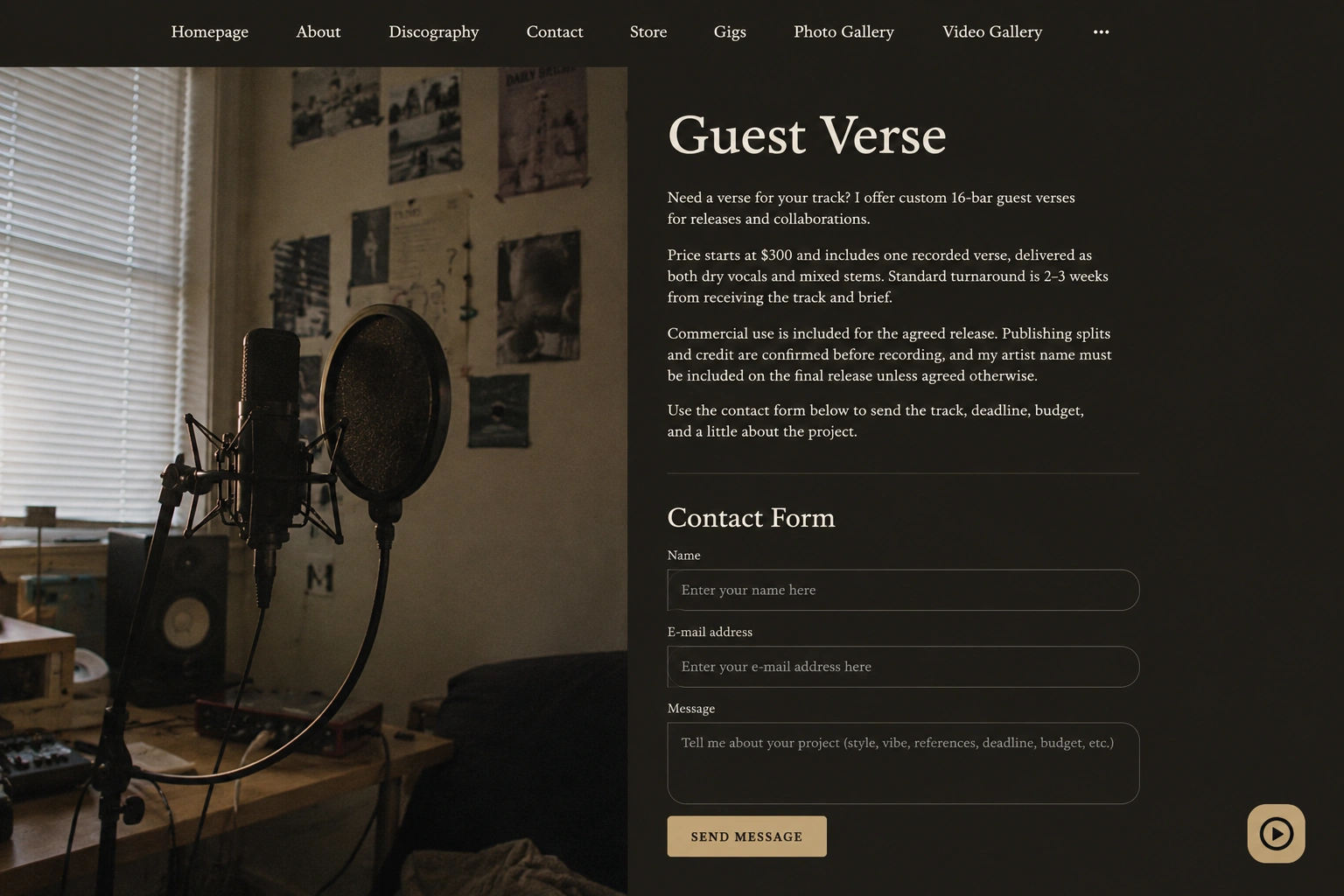
If people ask you for verses, the price conversation is already happening, usually in a DM at midnight. Publishing your terms on the site is what stops it happening there.
Write it as a service with four things in it:
-
What they get. Sixteen bars, mixed or dry, delivered as stems or a single file.
-
The price. A real number, or a range with what moves it.
-
The turnaround. Give a number of weeks, because "soon" tells a buyer nothing.
-
What happens after. Whether they can use it commercially, whether you keep a publishing share, and whether your name goes on it.
Written terms save you the back and forth with people who were never going to pay. They also make you read as someone who has done this before. The same page works for hooks, ghostwriting, or hopping on a show, and there's more on showcasing services on your website if you offer several.
Check the beat licence before you sell a track
Your licence decides what you are allowed to put in your own store, so read it before you list anything.
If you recorded over a beat you leased, you bought a non-exclusive licence. The producer can keep selling that same beat to other artists, and your licence almost always comes with limits attached. Typically that means a cap on streams, with an option to renew once you pass it. There is usually a term measured in years, and a requirement to credit the producer in the title or description.
There is usually a publishing split as well. On a non-exclusive beat, a 50% writing share for the producer is the usual starting point, and those splits are negotiable. Many leases also stop you registering the finished song with Content ID, because the same beat may be legally licensed to several artists at once.
None of that stops you selling the song. It does mean you should read the licence before you list it, and buy the exclusive if the track starts doing numbers. If you are unsure what yours says, ask the producer in writing and keep the reply.
Make it easy to book you
Bookings get lost in the gap between someone deciding to ask and working out how, so keep that step short.
Put one email address on the site, in the footer of every page, and use it for bookings. If you have separate management and press contacts, say which is which in three words each. Add a contact form too if you want one, and keep the plain email address alongside it, because plenty of people will skip a form.
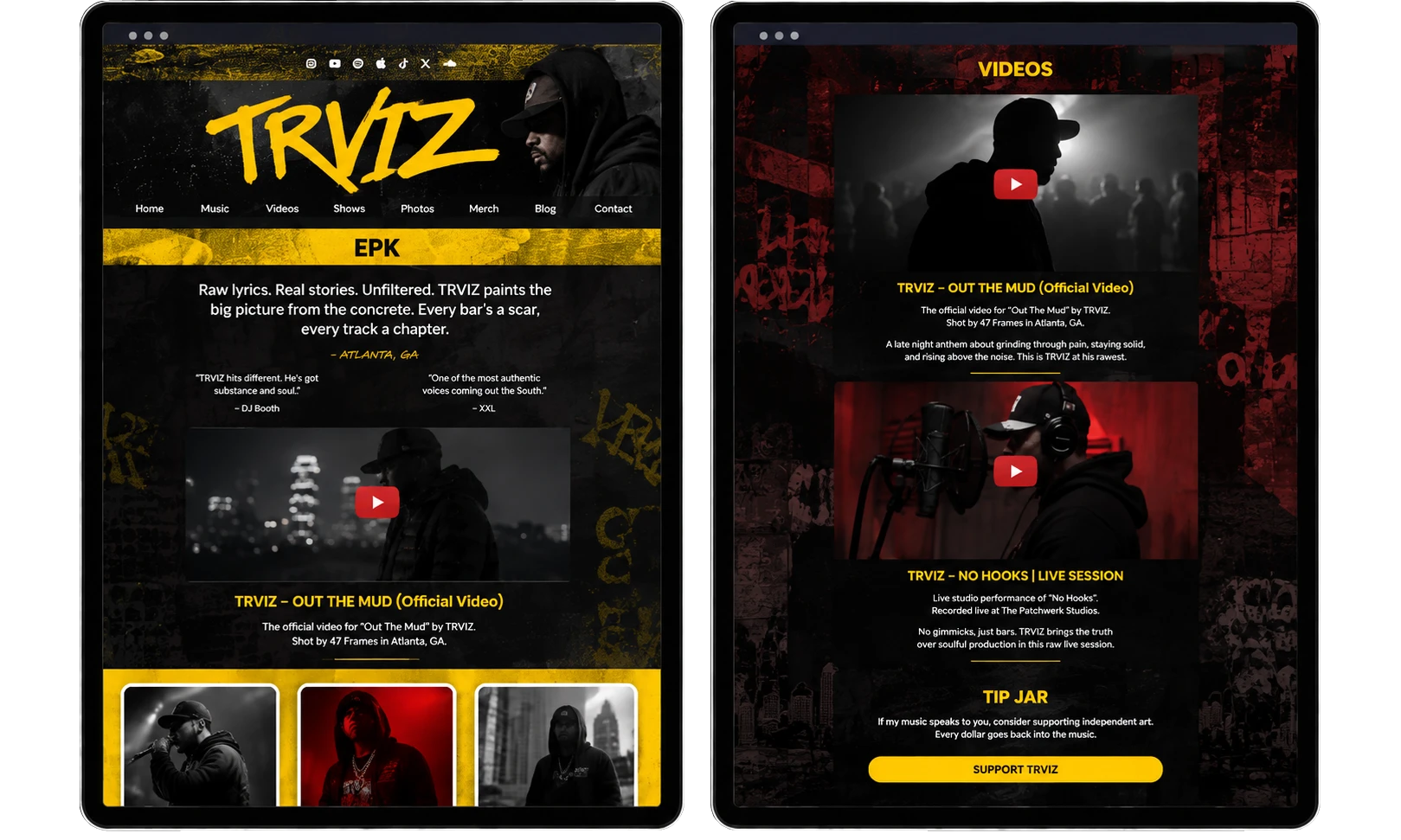
Everything a promoter needs to make the decision belongs on one page, which is what an EPK is for. There's a step-by-step guide to making an EPK covering what goes in it and how it should read. If you are still building the calendar those pages announce, the guide to getting gigs as a musician covers the outreach side.
Drops, merch, and the list that makes them work
Limited runs work in rap because the limit is genuine: a hundred shirts, a numbered tape, a colourway that does not come back. A drop sells when people know the hour it goes live, and a mailing list is what tells them.
Two things worth setting up before the first one:
-
A store that takes the money directly, so the sale happens on your domain and the buyer's email stays with you.
-
A mailing list you email the day of the drop. Building one from nothing is covered in the guide to building an email list as a musician.
Codes are useful here too. A download code printed on a card inside the tape gives the buyer the digital version, and it tells you who they are.

Photo by Harry Swales on Unsplash
Own your name in search
Rap names are often ordinary words, a common first name, or something with a number or a symbol in it. That makes you hard to find on purpose or by accident, and it means the first page for your name can fill up with things that are not you.
Your own domain is the strongest claim you have on that page. Use your artist name as the domain if it is free, and keep the same spelling everywhere. Link to the site from every profile you have, since those links are how a search engine works out which pages belong together.
If you are still deciding what to call yourself, or checking whether the name is taken, that decision comes first and there's a guide to choosing an artist name. For the technical side of ranking, the SEO guide for musicians covers what matters and what a builder should be handling for you.
How to build it
This is an afternoon of work if you keep it to the order below.
-
Get the domain first, before you write a word. Everything else can change later.
-
Put the video up. One video near the top of the homepage is enough to start.
-
Add the music. Releases in order with links out to stream and an option to buy.
-
Write the bio twice. A short one for the front page and a longer one for press.
-
Add the booking email, in the footer, on every page.
-
Add the store and the signup form when you have something to sell or a reason to email.
Music-focused builders come with the pages already shaped, so a video page, an EPK, and a store are things you switch on and fill in. The walkthrough for making a music website covers the setup end to end.
Build your own musician website
Music player, store, EPK, and mailing list, all built in. Start your 30-day free trial, cancel anytime.
Common mistakes to avoid
-
A splash page with your logo and nothing else. It adds a click before anyone hears anything, and some people will not take it.
-
Autoplay audio. People open sites at work and on public transport, and the tab gets closed before they hear anything.
-
Burying the contact. If a promoter has to hunt for it, they have already moved to the next artist on the list.
-
An unsearchable name with no site. If your name is a common word, a domain is the only result on that page you get to write.
-
Screenshots as press photos. A frame grabbed from a video is too low-resolution to print, and a journalist will ask you for something else.
-
Letting the shows page go stale. Dates from two years ago tell a promoter you are not currently playing.
Common questions
Do rappers need a website in 2026?
If you are only releasing music, no. Once anyone is booking you, paying you, or writing about you, yes, because those people need a contact, a bio, photos, and a rate in one place. A streaming profile holds none of that.
What should a rapper website include?
A video near the top of the homepage, your releases, and a press or EPK page with a bio and photos. Then show dates, a store, and a booking contact on every page. Six pages covers it. Add a services page if you sell verses.
Can I sell a song on my own site if the beat was leased?
Usually yes, and it depends on your licence. Non-exclusive leases normally cap streams, split publishing with the producer, and require a credit. Read the agreement before you list the track, and ask the producer in writing if the wording is unclear.
How much should I charge for a feature verse?
There is no standard rate, so set one you would be happy to be held to and publish it. Then state the turnaround, the format you deliver in, and whether you keep a publishing share, because those decide whether the number is fair.
Do I need a website if I already have a link in bio page?
A link in bio points people at other places. The website is where the store, the EPK, the mailing list and your search result live. Plenty of artists run both, with the link in bio pointing at the site.
Final thoughts
A small site does the job here. A video someone can play the moment they arrive, a contact that gets answered, and a page a promoter can read in a minute and decide from.
Get those three up first and add the rest as you need it, since each new thing you make will have somewhere to go.