Photo by Đồng Phục Hải Triều on Unsplash


Printful and Printify come up in every conversation about print-on-demand merch, and from the outside they look like the same service. You upload a design, a fan orders a shirt, someone prints it and posts it. The differences sit underneath: who does the printing, what a shirt costs you, how consistent the print is, and whether the sale happens on your own website.
This post is for musicians, bands and DJs who have decided to sell print-on-demand merch and want to know which of the two to set up. It compares the two on price, print quality, where they ship from, delivery times, returns, and how each one connects to a store. If you are still deciding whether print-on-demand is right for you at all, start with the guide to print-on-demand merch for musicians. It covers what to sell first, how to price it and the design mistakes to avoid. This one starts where that leaves off.
Printful prints in its own facilities, so the print is the same every time. Printify sends your order to one of 140+ independent print providers, so you pick the provider and the quality depends on that choice.
Printify's base prices tend to be lower for the same blank, because providers compete. Printful's are a little higher and include the consistency.
Both ship to the UK, Europe and North America from local facilities. Both give you 30 days to claim a misprint, and neither takes returns for a wrong size.
Printful connects to a store on your own website, so the fan buys on your page. Printify connects to Shopify, Etsy, Wix and similar, or a hosted Pop-Up Store on Printify's own domain.
Pick Printful if you want the store on your site and one consistent print. Pick Printify if the lowest base cost matters more and you sell through Etsy or Shopify.
Printful, for a band that sells from its own website and wants every shirt to come out the same. Printify, for a band that sells on Etsy or Shopify and wants the lowest base price on each item. The blanks are often the same garments, so the decision comes down to consistency, cost and where the sale happens.
Printful owns its printing. Orders go to one of its seven facilities in Latvia, Spain, the UK, the US, Mexico and Canada, plus partner facilities in Brazil, Japan and Australia for some products. Its system picks the facility for each order based on where the fan is and what is in stock. You never choose a printer, and you never need to.
Printify does not own a single printer. It is a marketplace of independent print providers, over 140 facilities at the last count, and for every product you pick which one makes it. Each provider sets its own base price, production time and shipping rates, and Printify gives each one a performance score based on quality complaints and delivery. You can let Printify choose for you, or compare providers and pick by hand.
That one difference explains almost everything else in this post. With Printful you are choosing products from a single printer. With Printify you are choosing a printer for each product, and the price, the quality and the delivery follow from that choice.
Both services are free to join and neither charges a fee per order. You pay the base price of the product plus shipping when a fan buys, and the gap between that and your retail price is what you keep.
Take the shirt most bands start with, the Bella + Canvas 3001. At the time of writing Printful lists it from $12.25. On Printify the same shirt is offered by several providers. At the time of writing the cheapest of them come in a few dollars under Printful's price, and the exact figure changes by provider, colour and size. Multiply a $2 or $3 difference by every shirt you sell and it adds up, which is why Printify wins for anyone whose margin is tight.
Both have a paid tier that lowers the base price. Printful Growth is $24.99 a month for up to 33% off products, and it becomes free once you pass $12,000 in sales a year. Printify Premium is $24.99 a month billed yearly, or $39 monthly, for up to 20% off all products. Neither is worth paying for until you are selling steadily, since a month's fee is several shirts' worth of margin.
Shipping is the other half of the cost. Printful publishes flat rates. A t-shirt to the US is $4.95 for the first item and $2.20 for each extra one. To Europe it is $4.99 and $1.45, and to the UK $4.79 and $1.50. On Printify each provider sets its own rates, so two providers of the same shirt can charge different postage. Check both the base price and the shipping before you pick a provider. The guide to pricing your music and merch covers how to set the retail price on top.
Get our new guides by email
Printful's advantage is that one company prints every order to the same standard, on the same machines, with the same inks. Order a sample, approve it, and the hundredth shirt looks like the first.
Printify can match that quality, because many of its providers are good, but you have to pick one and stay with it. A provider with a high performance score and a lot of completed orders is a safe bet. A cheap provider with a low score is where the bad reviews come from. Read the score, order a sample from the provider you intend to use, and do not switch providers on a live product without ordering another sample.
Either way, the garment itself decides how a shirt feels. Skip the cheapest shirt in the list, keep designs high contrast, and order a sample before you list anything. The print-on-demand guide linked above has the full list of design checks.

A shirt printed near the fan arrives sooner and costs less to post, and it avoids customs charges at the door. So the question is where each service can print for the countries your fans live in.
Printful covers the UK from Birmingham, the EU from Riga and Barcelona, the US from Charlotte and Dallas, Mexico from Tijuana and Canada from Toronto. Orders route automatically to the nearest facility that has the product in stock. For a band with fans on both sides of the Atlantic that means UK and EU orders stay inside the UK and EU without any setup on your part.
Printify's coverage depends on the providers you choose. There are providers in the US, the UK, across Europe, Australia and elsewhere, and the catalog shows each one's location. The catch is that you choose per product. If you want a UK fan and a US fan to get the same shirt printed locally, you set that product up with a provider in each region. Otherwise one of them waits longer and pays more for postage. Printify Choice can do some of this routing for you, but it is worth checking what it picked.
Printful quotes two to five business days to make an order. Standard shipping then takes three to four business days inside the US and Canada, or five to twenty business days internationally. Express options exist at a higher rate. Printful is clear that these are estimates, and busy periods like November stretch them.
Printify's production time is set by the provider, from about two business days for the fastest US providers to a week or more for embroidery and all-over prints. Shipping is then whatever that provider offers. In practice the two are similar for a plain printed shirt going to a fan in the same region as the printer. Both are slow for a shirt crossing an ocean.
Whichever you use, put an honest delivery estimate on the product page and in the order confirmation. A fan who was told to expect two weeks rarely writes to you on day ten, and a fan who was told nothing writes on day five.
The policies are close to identical, which surprises people.
Misprints, damage and lost parcels. Both give you 30 days from delivery to claim, and both reprint or refund at their cost. You submit the claim from your account with photos, and the fan does not have to send anything back.
Wrong size and changed minds. Neither accepts returns or exchanges for these, because every item is made to order. If you want to offer a size exchange, you place a new order at your own cost.
So the size guide on your product page is doing real work, because each exchange you avoid saves you the cost of a second shirt. Write a short returns policy for your store that says the same thing the printers say, so nobody is surprised, and point to it from the product page.
This is where the two part ways for a musician.
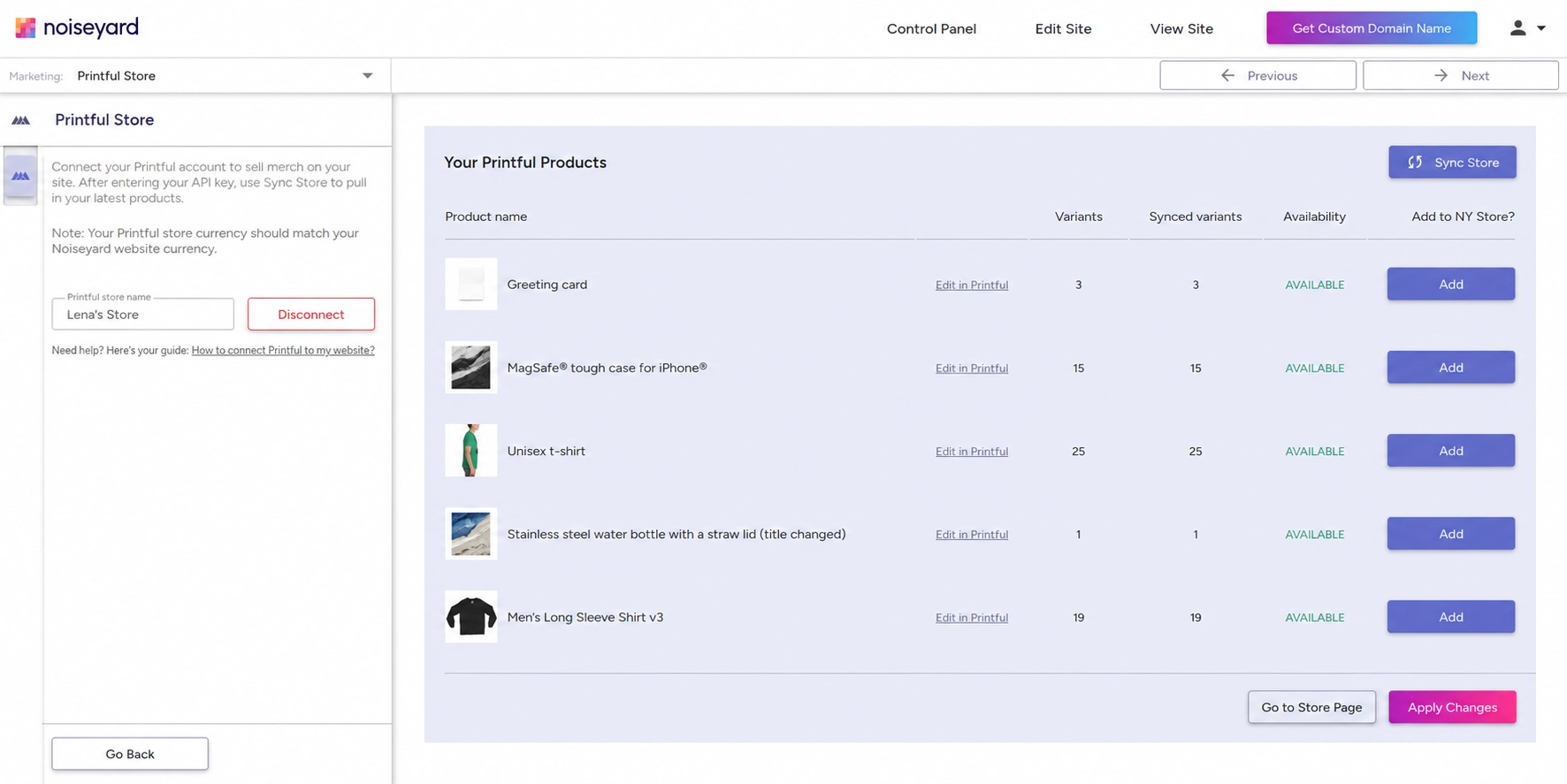
Printful connects to a Noiseyard store through Printful's API store type. Your Printful products sync into the store on your website, and the prices you set in Printful appear there. When a fan checks out on your site the order goes to Printful, which prints it and ships it. The fan never leaves your page, so the shirt sits next to your music and your dates, and the buyer's email is yours. There is a longer walkthrough of how the store and print-on-demand work together on a music website.
Printify connects to Shopify, Etsy, eBay, Amazon, TikTok Shop, WooCommerce, Wix, Squarespace and a few others, plus its own API for custom setups. If you do not run one of those, Printify offers a Pop-Up Store: a hosted page on Printify's domain that you link to from your site or your bio. It does the job, but the sale happens on their page, the checkout is theirs, and the fan's email stays with them. For a band whose website is the home base, that is the trade-off to weigh against the lower base price.
Plenty of artists run both, and it is simpler than it sounds. A common setup is Printful for the products in your own store, so the everyday shirts, hoodies and posters all check out on your site. Printify then covers a product Printful does not carry, or prints at a price you cannot make work, sold through a Pop-Up Store or an Etsy listing. Keep the same design files, the same blank where you can, and the same size guide, so a fan who buys from both gets the same shirt. If you also post a limited run yourself, signed vinyl for example, the guide to shipping band merch covers that side.
What you should not do is split the same product across both and let the two prices drift. Pick a home for each product and leave it there.
You sell from your own website and want the fan to check out there. Printful, because it connects to the store on your site.
You sell mainly on Etsy or Shopify and margin is the priority. Printify, for the lower base prices and the platform integrations.
You want one print standard with no provider research. Printful.
You are happy to research providers and order samples from two or three. Printify, and you will probably save a couple of dollars a shirt for the effort.
Your fans are split between the UK, the EU and the US. Either, with Printful needing no setup and Printify needing a provider per region.
You are testing your first two products and have no idea what will sell. Either. The base price difference on a handful of shirts is small, so pick the one that fits your store.
Once one design sells steadily, the numbers from either service tell you what to bulk print for the merch table, where the margin per shirt is far better. The merch table guide covers that side, and the wider guide to selling music and merch online covers what else belongs in the store alongside the printed items.
Build your own musician website
Music player, store, EPK, and mailing list, all built in. Start your 30-day free trial, cancel anytime.
Choosing Printify and never looking at the provider. Printify Choice picks by its own rules. Check the provider's location and score for every product you list.
Comparing base prices without the shipping. A provider that is $2 cheaper on the shirt and $3 dearer on postage costs you more.
Paying for Growth or Premium on day one. Both discounts are for stores already selling. The fee is several shirts' worth of margin a month.
Listing without a sample. On Printify this matters twice over, because you are approving a specific provider, not the platform.
Offering free size exchanges without pricing them in. Neither service takes a wrong-size return, so every exchange is a second shirt you pay for.
Sending fans to a Pop-Up Store when you have your own site. The sale, the checkout and the fan's email all stay on the other domain.
Is Printful or Printify cheaper?
Printify, on the base price of the same shirt. Its providers compete, and the cheapest ones undercut Printful by a few dollars. Add the provider's shipping before you compare, since Printful's flat rates are sometimes lower. Both are free to use, and the paid tiers on each only pay off once you sell steadily.
Which has better print quality, Printful or Printify?
Printful is more consistent, because it prints everything in its own facilities. Printify can be just as good if you pick a provider with a high performance score and stay with it. On either, order a sample before you list a product, and again if you change the blank or the provider.
Does Printful or Printify ship to the UK and Europe?
Both do, from local facilities. Printful prints UK orders in Birmingham and EU orders in Riga or Barcelona and routes them automatically. Printify has providers in the UK and across Europe, but you choose the provider for each product, so pick one in the region your fans are in.
Can I use Printful or Printify with my own music website?
Printful connects to a store on a Noiseyard site, so the products sync in and fans check out on your page. Printify connects to Shopify, Etsy, Wix, Squarespace and similar platforms, or you can link to a Printify Pop-Up Store hosted on their domain.
What happens if a fan orders the wrong size?
Neither service accepts wrong-size returns, because every item is printed to order. If you want to offer an exchange, you order a replacement at your own cost. A clear size guide on the product page prevents most of these, so put one on every listing.
Printful and Printify sell the same shirts, and the difference is what you are buying with the margin. Printful charges a little more and gives you one consistent print, automatic routing to the nearest facility, and a store that lives on your own website. Printify charges a little less and gives you the choice of printer, along with the job of choosing well.
For a band selling from its own site, Printful is the simpler fit. For a band selling on Etsy or Shopify with tight margins, Printify earns its lower price. Start with two products on whichever you pick, order a sample, and let the first month of orders make the rest of the decision.
Get our new guides by email.
Practical advice on promoting your music, getting gigs and selling online. You can unsubscribe at any time.