Photo by Johan Mouchet on Unsplash


This guide is for bands and solo artists who play shows, release music or sell merch under a name they plan to keep. It explains how to register that name with the US Patent and Trademark Office (USPTO), what it costs and what proof to send. It covers the US only, since a USPTO registration protects the name in the US and its territories. Fees and wait times are as of November 2026.
Your rights from using the name only cover the areas where you use it. For rights across the whole country, register it with the USPTO.
Filing starts at $350 per class. Live shows, T-shirts and recordings are three classes, which comes to $1,050 before any extra fees. For recordings, the name can register only once it's on at least two different releases.
Register the name as plain text. A logo needs its own application and its own fees.
If your band members own the name together without a partnership or company, list every member as an owner.
Send proof of use for each class, such as a photo of the band on stage with its name on the drum for shows. For merch, a store page can count if your band name shows near the product with the price and a Buy button. Capture it with the page's URL and date.
In November 2026, applications took 10 months on average from filing until they were either registered or abandoned, meaning the USPTO stopped processing them.
Yes. Your band name can be a trademark for your shows, recordings and merch. Using the name gives you rights only in the areas where you use it, and a USPTO registration covers the whole US. The base filing fee is $350 for each class you file in.
A trademark covers the name as you use it for certain goods or services, so the application lists each one, such as live shows or T-shirts. Your songs fall under copyright, a separate system explained in our guide on how to copyright a song.
No, registering is optional. You can register with your state, which covers that one state, or with the USPTO. A federal registration brings these benefits:
Your name appears in the USPTO's public database, where anyone searching for a similar name sees it.
The law presumes that you own the name and have the right to use it.
You can sue over the name in federal court and use the ® symbol.
Once you record the registration with US Customs and Border Protection, Customs can stop imported goods that carry an infringing mark.
The registration can be the basis for applying in other countries, for example through the Madrid Protocol, a treaty with over 100 member countries.
The USPTO isn't an enforcement agency, so even after registration, it's up to you to act if someone else uses the name. In some cases, someone who used the name before you can still take action against you, even if you're registered and they aren't.
To decide, weigh the fees against what a forced rename would cost you. That could mean reprinting merch, changing the artwork on your next pressing, moving to a new web address and renaming every profile. A band that has pressed records and gone on a DIY tour under its name has more to redo than one that has only played locally.
If the band is new and the name might still change, you can wait. Once you're sure of the name, an intent-to-use application lets you file before you use it and gets you an earlier filing date (see step 2).
The owner can be the person, group or business that controls the quality of what's sold or performed under the name. The USPTO's page for musicians covers these cases:
Solo artist. You file in your own name, as an individual.
Band with no partnership or company. If the members own the name together, the application lists each member as an individual owner, with their citizenship. You don't need to form a business to apply.
Band with a partnership, LLC or corporation. The business files under its own name, with the state where it was formed. A partnership with no business name files under its general partners' names. A US partnership also lists each general partner's name and citizenship.
Before anyone files, agree in writing who keeps the name if a member leaves or the band splits up.
When ownership changes later, such as a member leaving or the band forming an LLC, record the change with the USPTO's Assignment Recordation Branch. You send the document behind the change, such as an assignment that transfers the name, and pay a fee.
If the name you file includes a living person's name, such as a solo artist's own name, the application needs that person's signed consent. It also states that the name identifies a living person whose consent is on record. If it only looks like a person's name, the application must say it doesn't identify a living person. Leaving any of this out adds the $100 per class fee for missing information.
Get our new guides by email
A band's shows, recordings and merch usually fall into four of the USPTO's 45 classes:
| Class | What a band files there | USPTO examples |
|---|---|---|
| 9 | Recordings | Downloadable musical sound recordings, CDs |
| 16 | Paper merch | Posters, stickers |
| 25 | Clothing | T-shirts, hats |
| 41 | Shows | Live musical performances |
Start with what you use the name for today. A band that mostly plays live might file in Class 41 alone for $350, then file again later for posters, stickers or shirts. For Class 9, a use-based filing needs your name on at least two different releases. With one release out, leave recordings for later or file them on intent to use (step 2 below).
The table shortens the USPTO's examples. Pick each description from the ID Manual, a list of descriptions the USPTO accepts, by searching it inside Trademark Center, the online filing system. Typing or pasting a description into the free-form box costs $200 more per class.
If you file based on use, you must already use the name for every item you list. You sign that under penalty of perjury, so leave out anything you don't sell yet.
Filing costs $350 per class, and the fees below can come on top. They're from the USPTO's trademark fee page and its full fee schedule:
Missing information: $100 per class if the application leaves out required details, such as your domicile address (your permanent legal home, or a company's main place of business).
Your own wording: $200 per class for a description typed or pasted into the free-form box.
Intent to use: $150 per class when you show use later, and $125 per class for each request for more time to show use.
Maintenance filings: these declare that you still use the name and keep the registration alive. They cost $325 per class between years 5 and 6 after registration, then $650 per class between years 9 and 10 and every 10 years after.
Late maintenance filings: every deadline has a six-month grace period, and a late filing costs $100 extra per class. The 10-year filing combines a declaration of use and a renewal, so filing it late costs $200 extra per class.
For example, a band that plays shows in several states and sells T-shirts online files on a use basis in Class 41 and Class 25. Because it picks ID Manual wording and fills in all the required details, it pays only the base fee of 2 × $350 = $700. If it meets every deadline, maintenance adds 2 × $325 = $650 between years 5 and 6. The first renewal, between years 9 and 10, adds 2 × $650 = $1,300. That's $2,650 in USPTO fees through the first renewal, at these rates.
Fees are generally not refunded, even if your name is refused.
If you file yourself, the search, the wording, the proof and the replies to any USPTO letters are all on you. A trademark attorney's fee comes on top of the USPTO's. In return, an attorney can run a clearance search before you file and handle those letters.
For each class, you send one real example of the name in use with your goods or services, which the USPTO calls a specimen. A mockup, a test print or a draft of a website doesn't count. For any webpage, include its URL and the date you captured it, which can go in the screenshot itself.
For CDs, send a photo of the name printed on the discs or their packaging. The name has to appear on a series of recordings, meaning at least two different works. You also have to show that the name tells buyers the recordings come from you. One way is a signed statement that you produce them and control their quality.
The same album on CD and on vinyl counts as one work, so a vinyl pressing of an earlier CD doesn't make a series. A solo artist's name or stage name follows the same series rule.
A webpage that sells the item can also be your proof. The USPTO's example shows the name on or close to the product, the price and a shopping cart button. For downloads, use a page with a "buy" or "add to cart" link that makes clear the music is available to download.
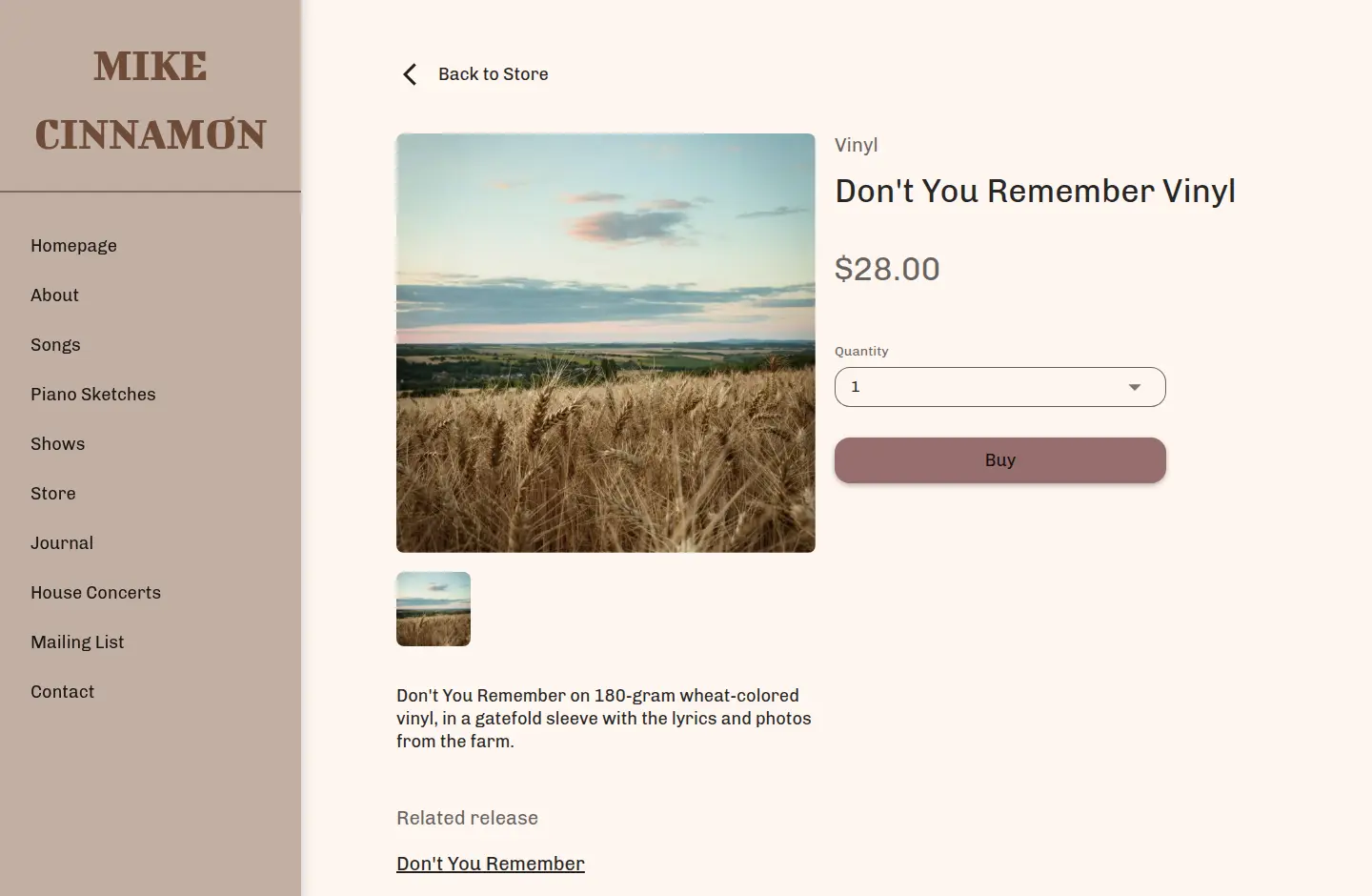
When you sell through your Noiseyard store on the Standard or Unlimited plan, each product page shows the item's pictures, name and price. Its Buy button opens a window to add the item to the cart or check out. Before you capture the page, check that your band name shows next to the product. For recordings, capture pages for at least two different releases. In the demo page below, the artist's name is the site title at the top left, so you'd add it to the product's title first.
The USPTO says a name printed big across the front of a shirt is likely to look like decoration that shows the wearer supports the band. A photo like that can be refused as ornamental. A tag inside or outside the shirt, or small wording on the chest or pocket, usually tells buyers who made the shirt.
One fix the USPTO names for this refusal is a photo of the name on a shirt tag. For a use-based filing, you must already be selling shirts with that tag by your filing date. If your shirts don't have a label with your name yet, get neck labels from your printer, then sell labeled shirts and photograph one before you file. If you've already filed, switching shirts to intent to use can let you send the photo later.

Live shows have more options, because advertising counts for services. Ads, brochures, website printouts such as your gigs page, and other promotion can all serve as proof when they show the name used for your shows. So can a photo of the band on stage with its name on the drum.
For shows, the USPTO needs no evidence of a series. You must already be playing them under the name, since a service is in use only once you provide it.

Your own website can hold both kinds of proof: store pages for your merch and recordings, and a gigs page for your shows.
Build your own musician website
Music player, store, EPK, and mailing list, all built in. Start your 30-day free trial, cancel anytime.
Search the USPTO's trademark database for names that look or sound like yours, have a similar meaning or leave a similar overall impression. A similar name is a problem when it's used for related goods or services, even ones in a different class from yours. If a registered mark like that blocks yours, the refusal can be hard or impossible to get past.
Only live filings, meaning ones still active, can block your application. Check dead ones too, because their owners may still use the name. The USPTO's search covers federal filings only, so search state trademark databases and the web as well. For the everyday checks, such as streaming platforms and social profiles, see the artist name guide.
You can choose from four filing bases. Two of them rely on a filing in another country. A US band usually picks from the other two, use and intent to use.
Both depend on "use in commerce," which has a legal meaning. Use within one state generally doesn't count, unless it directly affects commerce between states or with other countries. The USPTO's examples include services advertised in more than one state and services offered online nationally. Shipping merch you sell online to fans in other states also counts. The use also has to be genuine trade, and a token sale made only to reserve the name isn't enough.
Use. You already use the name in commerce for everything you list. You give two dates: when you first used the name anywhere, and when you first used it in commerce. You also send one proof of use per class.
Intent to use. You plan in good faith to use the name soon. This gets you an earlier filing date, which can give you priority over someone who files later. The name can't register until you prove use and pay $150 per class. Keep a record of your plans, such as shirt designs and printer quotes, since anyone who opposes your filing can question your good faith.
You can mix the two by class, for example a use basis for live shows and intent to use for shirts you haven't printed yet.
Create a USPTO.gov account with two-step sign-in, then verify your identity. This one-time check usually takes under 15 minutes online, and there's a paper option.
You enter the owner, the name, your classes with their descriptions and the filing basis. For a use basis, you also add your dates and proof. You pay by credit or debit card when you file. If you trigger the extra fee for missing information or for your own wording, Trademark Center asks you to tick a box before you continue.
Enter the name in "standard characters," meaning plain text in no particular style. This gives the broadest protection, since it covers the wording in any font, style, size or color. A logo is a "special form" mark, protected only as drawn. Each application covers one mark, so a logo means a second application and a second set of fees. Our branding guide covers whether musicians need a logo.
A USPTO lawyer called an examining attorney reviews your application and searches for conflicting marks. If there's a problem, you get a letter known as an office action. You have three months to respond, and you can pay $125 for three more. Miss the deadline and the application is abandoned, meaning the USPTO stops processing it. If you missed it by accident, you may be able to revive the application with a $250 petition filed within two months of the abandonment notice.
Check your application's status in Trademark Center every three to four months, as the USPTO suggests. Every official letter also appears in TSDR, the USPTO's online record of each application.
Once approved, your name is published in the USPTO's weekly Official Gazette. Anyone who believes the registration would harm them then has 30 days to oppose it or ask for more time. If nobody does, a use-based application goes on to registration.
An intent-to-use application gets a notice of allowance at this point, which says the name can register once your proof of use is accepted. You then have six months to show use, and extensions can stretch that to 36 months.
Once the name is registered, use the ® symbol with it, but only for the goods and services in your registration. Before that, you can use TM for goods or SM for services, even without filing.
To hold on to the registration, keep using the name and send each maintenance filing on time, with new proof for each class. The first is due between years 5 and 6 after registration. Miss a deadline and its grace period, and the registration is canceled or expires. You'd then have to apply again from the start. Email reminders come from the USPTO, but the deadlines apply even if one never arrives.
If you stop using the name on something in the registration, such as hats, delete hats from your list of goods, which costs nothing between maintenance filings.
Some private companies send notices with words like "Trademark" or "Office" in their names, pushing paid services and threatening the loss of your rights. Real USPTO emails end in @uspto.gov. Before you reply to a notice or pay anything, check that it also appears in your file in TSDR.
If another act uses a confusingly similar name, the USPTO says to consider hiring an experienced trademark attorney.
Picking a name that only describes what you do. The USPTO says creative names are "more effective and easier to protect."
Proof that shows a different version of the name. Such proof can be refused, so match the words you filed exactly.
An old email address on file. USPTO letters and reminders come by email, and a missed letter can mean a missed deadline. Update your address whenever it changes.
Thinking a business filing or a domain protects the name. Forming an LLC or filing a business name with your state registers the business. Using a business name doesn't necessarily count as trademark use, and registering yourbandname.com gives you no trademark rights.
No. The US Copyright Office says names aren't protected by copyright law. It adds, "Some names may be protected under trademark law." A logo's artwork can have copyright if there's enough creative work in it, and a logo you use as a brand can also be a trademark.
Not if you live in the US, though the USPTO strongly encourages hiring a US-licensed trademark attorney. If you live outside the US, you must have one to file with the USPTO. Free and reduced-cost legal help also exists, such as law school clinics. Trademark filing services aren't law firms, and the USPTO doesn't endorse them.
On average, applications got a first review 4 months after filing and were registered or abandoned after 10 months, by the USPTO's November 2026 figures. An intent-to-use application has extra steps, since it can't register until you show use.
Not as the title of a single album. The title of one album or song counts as the title of a single creative work, which the USPTO won't register. A title used on a series of different works can register.
No. For clothing, send a photo of the name on a shirt label, and for shows, an ad or poster. A website gives you pages to capture with a date each time you need proof, from showing use to each maintenance filing.
Get our new guides by email.
Practical advice on promoting your music, getting gigs and selling online. You can unsubscribe at any time.