Photo by Tom Pottiger on Unsplash


This guide is for composers who write music for films, TV, games, ads or theater, and for concert composers who take commissions. It covers the pages a composer portfolio needs to get you hired: a reel, a credits list, your services and a way to reach you.
Games and concert music each need something extra, such as a gameplay video or a list of works with score pages.
Put a short video reel of your music set to picture near the top of your site, and open it with your strongest piece.
List every credit with your role and the director or studio, and add a short cue where you can share one.
If you write for games, show your music in a gameplay video, and say which parts you built.
For concert works, show performers the instrumentation, the length, a recording and sample score pages.
Write a page for each service that says what your fee covers, and make the contact form easy to find from your reel.
A composer website needs a short reel of your music set to picture and a list of your credits, with cues people can play. Add your music grouped by type of project, a page for each service, a short bio with a photo and a contact form. Put the reel and your strongest credits first.
The person hiring wants to know whether your music works with a scene, whether you've finished projects for other people, and how to reach you. If you're building the site from scratch, start with the reel, the credits and the contact page, then add services, a bio and press as you go.
On a film or TV project, the director and the producers usually choose the composer. Filmmakers often find you through a recommendation or a piece of music they liked, and may then ask to hear your reel. On a game, the choice can sit with the developer, the studio's audio team or the publisher's music staff.
Before choosing, a director can also ask for a demo written for their own project. Film Independent's guide to quick demos describes two steps. First you may be asked for a piece in the style the director wants, typically up to three minutes. Then you write music for one of the film's scenes, delivered the way it would sound in the final film. Short pieces in different styles on your site let a director hear what you can do before asking for a demo.
Getting songs you've already made into films and shows works differently. A music supervisor, usually hired by the producer, picks and licenses those songs, and our guide to getting your music into film and TV covers that side.
A reel is a short video of scenes with your music under them. Many filmmakers like a video reel because it's a quick way to hear your work. An audio playlist is worth keeping too, since plenty of composers get work with music-only demos.
Your main reel should show range: tense, tender, light and big cues, in the styles you want to be hired for. Open with your best piece and end with your second-best. When you pitch for a particular film, cut a version with only the music that fits it. Put each project's name on screen at the start of its clip.
There's no industry standard for length. Film Scoring Tips suggests 2 to 4 minutes as a rule of thumb, and the reels in a survey it published in 2019 ran from 60 seconds to 10 minutes. You might get away with a longer reel for someone who has already shown interest in you. For a first reel in a few styles, Brandon Young, then director of music affairs at Activision Blizzard, recommended a minute and a half to two minutes per style. Three styles at that pace run 4.5 to 6 minutes, so keep only your strongest styles if you want a shorter reel.
For footage, use scenes from projects you scored that the production lets you show, student films whose directors agree, or films released for reuse. Blender's open movie Sintel is licensed under Creative Commons Attribution 3.0, which allows reuse as long as you give credit. Sintel's licensing page gives the credit for a clip and asks you to keep the full credits scroll when you show the whole film. Either way, say you replaced the music and link to the license.
Host the reel on YouTube or Vimeo and embed it on your site. Young warned against large attachments: "If they email me a 20Mb file that jams my inbox, it discredits them and I'm going to delete the attachment." When someone asks for your reel, email a link to it. On Noiseyard, a Video Section on your homepage plays a YouTube or Vimeo link and can show a button to your contact page, on every plan.
Give each project its own entry: the title, the kind of project, the director or studio, the year and your role. In a theater or ad credit, the theater company or the agency takes the place of the studio. Name the role plainly: composer, additional music or orchestrator. Where the production allows it, add a short cue that plays on the page. Festival selections and awards belong in a film's entry too, and a film or TV credit can link to its IMDb page when the project has one.
Student films, festival shorts and small games all count. Put your newest or best credits at the top. If you work in film, TV and games, split your credits into a list for each, so a game studio can go straight to your game music.
Noiseyard's Other Works page fits a credits list when you add it with Music as its type. Each entry has a name, a date, notes, links and a player, and its own page shows the date. You can make separate pages like this for film, TV and game credits. Embedding a track or a video works on any plan. Uploading tracks for the site's own player needs Standard or Unlimited, and a page set to uploads plays tracks only.
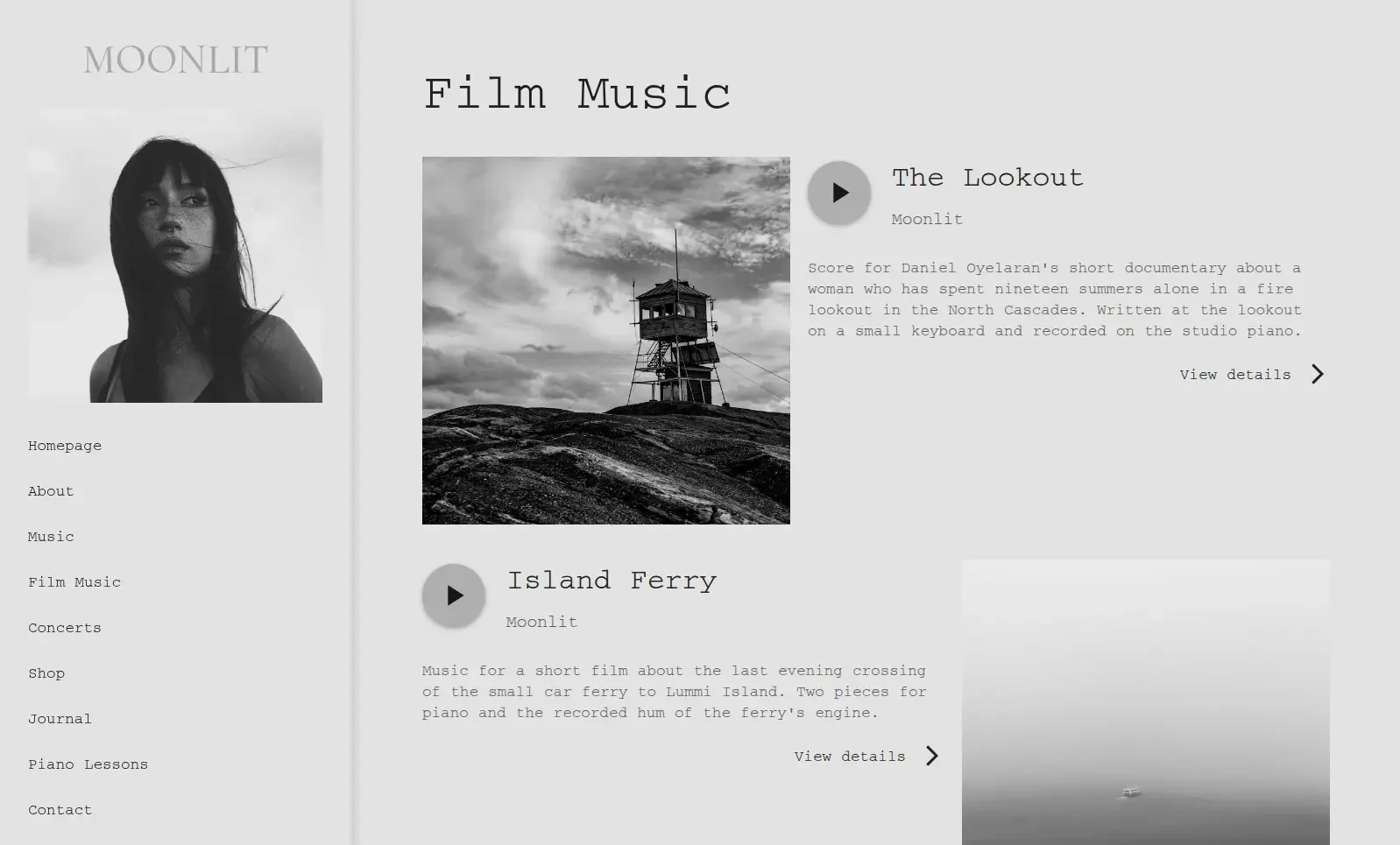
A gameplay video with your music shows how it sounds in play. If the music changes with what the player does, let the video show it: a fight starting and ending, or the player walking from one area into the next.
When you've also implemented the music in the game, say so in the credit. Then show a little of the system behind it, such as the layers you built and the middleware or engine tools you used. Your services page should say if you can deliver music as loops or separate layers.
Young's advice for anyone without experience was to mute a game clip and write a new score to it. For your site, use gameplay you have permission to show, such as a game jam project your team is happy to share.

For concert music, write each entry for a performer deciding whether to program your piece. List the title, the instruments, the length, the year and who premiered it, with a recording and a few pages of the score. Add the practical details a performer needs, such as how hard the piece is and where to get the parts.
Label each recording with the performers and the date. The classical musician website guide goes further into presenting repertoire and recordings. Where a publisher or a score shop sells a work, link to its page there.
Commissions need their own short note: what you write, how much notice you need and how someone can ask you for a new piece.

Make a separate page for each kind of work you offer, such as scoring, orchestration, arranging or lessons. On your scoring page, say what your fee covers:
the spotting session, where you and the director decide where the music goes
the writing, and how many rounds of changes are included
live players and recording, if the budget covers them
the mix, and delivery of the final music in sync with the picture
Put a starting price on the page so people know what to expect before they write, or say you quote per project. If you're not sure what to charge, start with the services section of our pricing guide.
A Noiseyard Service page holds text, an optional picture and links, such as a link to your contact page. Producing or mixing work gets its own pages, and the producer website guide covers them.
On the contact page, ask people to include the kind of project, its length, the deadline and the budget, so your first reply can cover price and schedule.
Keep the bio short and about the work you want: what you score, who you've worked with and the sound people hire you for. For examples and a template, see how to write an artist bio.
Add a photo of yourself, such as one in your studio, and a few lines from directors you've worked with, used with their permission. Interviews and reviews can go on a press page or an EPK, and what to include in an EPK walks through the sections.
Look for a website builder with a music player, video embeds, pages you can use for credits and services, and a contact form. You can see the options side by side in our comparison of website builders for musicians.
Use your name as the domain, so a director who remembers your name can type it in. Then answer inquiries from an email address at that domain. Say "composer" and the kind of work you do, such as film or games, in your homepage text.
The steps to set up a music website are the same for composers. With the reel, the credits and your services on your own website, you can answer every request for your work with the same link.
Build your own musician website
Music player, store, EPK, and mailing list, all built in. Start your 30-day free trial, cancel anytime.
Long intros on reel clips. Cut the lead-in before the music starts, and drop sections that repeat.
A credits list that stopped years ago. Write each entry as soon as the project ends, with the cue and the director's details fresh.
A reel on a download link. Keep it on a video site and embed it on the page.
Music that starts on its own. Let visitors press play themselves.
No way to reach you near the reel. Put the contact form, or a link to it, close to the music.
You can start without one. For a first pitch, a reel on YouTube or Vimeo and a list of credits can be enough. A website lets a director who heard about you from another filmmaker play your cues and read your credits before writing to you.
Aim for about 2 to 4 minutes, the rule of thumb from Film Scoring Tips, and keep longer reels for people already interested in your work.
Yes, for practice, and Berklee's career page for film composers lists it as one way to get experience. To post a rescore, use a film that allows reuse, such as Blender's open movie Sintel, and credit it the way its license asks.
Score student and low-budget films, especially ones likely to play at festivals, and join small game projects. When you agree to score one, ask for a credit and for permission to post a cue from it.
You can post it once your agreement or the production allows it. Check the agreement first, since it may already say what you can share and when. If it doesn't, ask the production and keep their answer in writing.
Get our new guides by email.
Practical advice on promoting your music, getting gigs and selling online. You can unsubscribe at any time.