WEBSITE TIPS
What to Put on a Classical Musician Website: Repertoire, Recordings and Concert Details

Deniz

Sep 8, 2026
A concert presenter asks for your website after hearing you play. They want to listen again, see which programmes you offer, and find out whether you perform solo or with an ensemble. A biography and a portrait leave several of those questions unanswered.
This guide is for classical instrumentalists, singers and chamber musicians preparing that information. It covers how to present repertoire, label recordings and describe a concert programme, with a piano recital example you can adapt to your own work.
TL;DR
-
Give your classical musician website a clear description of your instrument or voice, performance work and location.
-
Group repertoire by the instruments and voices needed, and identify which works or programmes you can currently offer.
-
Describe a proposed programme with named works, approximate playing time, performers and any venue requirements.
-
Label recordings with the composer, work, movement and performers so visitors know who and what they are hearing.
-
Keep concert details, publicity materials and the correct booking contact current.
Table of contents
What should a classical musician website include?
A classical musician website should include your instrument or voice type, a short biography, clearly labelled recordings, repertoire or proposed programmes, concert dates, publicity photos and a booking contact. Give presenters enough detail to understand the music you offer, who performs it, how long it lasts and how to enquire.
Start by describing the work you're available for. “Violinist based in Bristol, performing solo recitals and chamber music” establishes your location and the kinds of engagement you offer. A singer might name their voice type and the recital or oratorio work they undertake. Use descriptions that reflect your current practice.
Let visitors hear a relevant performance near that introduction. Then give them clear routes to Repertoire, Concerts and Contact. Our music website homepage guide covers the wider question of how to order the front page; the sections below deal with the performance information behind it.
Organise repertoire by performance setting
A presenter planning a lunchtime recital needs to know which pieces suit the slot and the available performers. Grouping your repertoire by instrumentation helps them read the relevant part without sorting through everything you've studied.
A violinist could separate unaccompanied works, violin and piano, chamber music, and concertos with orchestra. Within each group, alphabetical order by composer makes a long list easier to check. For vocal work, you might use song recitals, oratorio and opera roles, depending on what you offer.
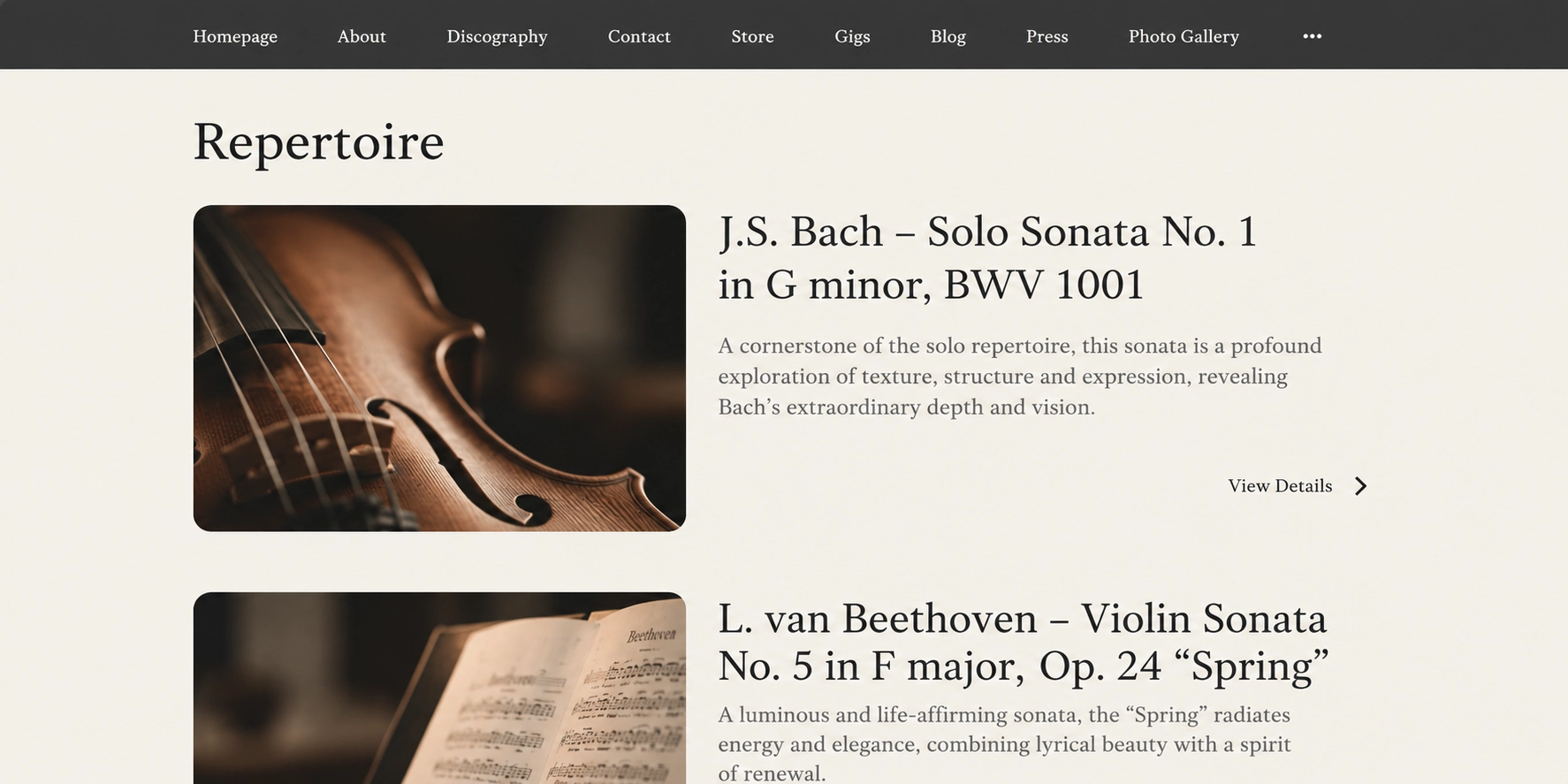
Include the composer's name, the work's full title, an opus or catalogue number where relevant, and the instrumentation. Specify the movement if you're offering an extract. Where a work exists in several versions, identify the arrangement you're performing.
For an example of useful repertoire detail, the Royal College of Music's guides to music by émigré composers group works by ensemble and include durations, publishers and recordings. A performer's own list can be shorter, with the information a presenter needs to discuss an engagement.
Make the status of the list clear. “Selected repertoire available for recital bookings” makes a different commitment from “Selected past performances”. If a piece would need substantial preparation before you could perform it again, explain that when discussing a date. For opera, distinguish a complete role you've performed from individual arias or scenes you've sung.
Keep the list as readable text. A photograph of an old concert programme is difficult to consult on a phone, and it leaves visitors wondering which of those works you still offer.
Show a programme a presenter can assess
Alongside your wider repertoire, describe one or two programmes you're prepared to discuss. A named set of works gives a presenter something concrete to consider for their concert series.
Here's an illustrative solo piano programme. The timings are approximate planning estimates; use timings from your own playing when preparing a proposal.
Example: a short solo piano recital
| Composer | Work | Approximate playing time |
|---|---|---|
| J. S. Bach | Italian Concerto in F major, BWV 971 | 13 minutes |
| Clara Schumann | Three Romances, Op. 21 | 12 minutes |
| Claude Debussy | Estampes | 15 minutes |
The music adds up to about 40 minutes. An event description could read: “Solo piano recital with music by Bach, Clara Schumann and Debussy. Approximately 45–50 minutes including short spoken introductions and applause, without an interval.” Check that allowance against the way you present the programme.
State the instrumentation even where the title seems familiar. Bach's Italian Concerto, BWV 971 was written for solo keyboard, so the example above requires one pianist throughout.
Add a short practical paragraph underneath. For this recital, say which type of piano you need, then agree the instrument, tuning and rehearsal access with the venue. A chamber programme should name the players or explain how the ensemble will be assembled. If you offer a version with a different line-up, describe it separately.
Include a listening link to a work in the proposed programme when you have one. A label such as “Hear the Andante from Bach's Italian Concerto” tells the presenter what that recording demonstrates. Use the same work titles on the programme and the recording so they can connect the two.
Label recordings so people can judge the performance
Choose a small selection that represents the work you're seeking. If you're proposing recitals, include a complete movement or piece that lets someone follow your phrasing and pacing. A chamber booking also calls for a recording in which they can hear you playing with others.

Photo by Tuyen Vo on Unsplash
Put the work and your role beside each recording. Include the composer, title, movement, performers and recording date, plus the venue or session context where useful. In a duo recording, name both musicians and their instruments. In an orchestral clip, explain whether you are the soloist, conductor or an ensemble member.
For the piano example above, a recording description might follow this pattern: “J. S. Bach: Italian Concerto in F major, BWV 971, II. Andante. [Performer name], piano. Recorded at [venue], [month and year].” Replace the brackets with the actual credits before publishing.
Choose recordings that still represent how you perform. Clear sound helps someone hear articulation and balance; a distant phone recording with heavy distortion makes those harder to assess. An older recording can still be useful when its date is visible and you remain comfortable sending it to a prospective presenter.
Check that each video plays while you're logged out of its hosting account. If you only have an extract, label it as an extract. Keep any applause or spoken introduction in proportion so a visitor can reach the music without searching through a long video.
Give each concert enough detail
For an upcoming concert, show the date with the year, performance time, venue, city, programme and fellow performers. Link to the specific event or ticket page. A listing called “Recital” with a venue name leaves a listener to find the rest elsewhere.
Name your part in the event. State whether you're giving a solo recital, playing in a named ensemble or appearing as a concerto soloist. If the full programme is still being agreed, publish the confirmed details and add the works when they're announced.
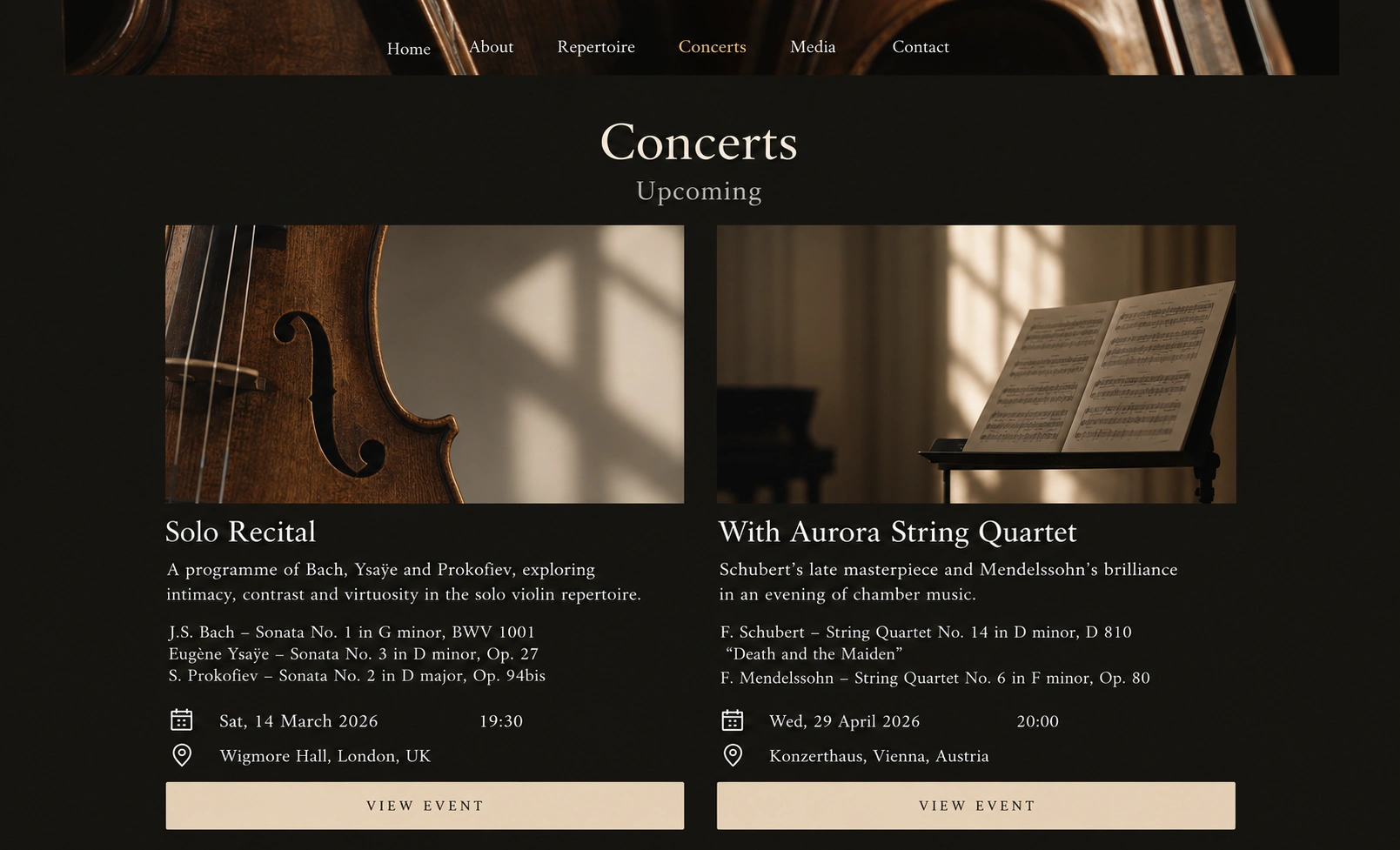
Keep past performances clearly separate from upcoming dates. An archive can show the range of your work, with the year and your role attached to each engagement. Update cancellations and postponements as soon as the presenter confirms them, including any changed ticket information.
If you're preparing several appearances, our guide to keeping your website updated during a tour or release covers the broader update routine. For a recital season, check each public listing against the presenter's event page before sharing it.
Prepare your bio and publicity photos for reuse
Once an engagement is agreed, someone may need your biography for a printed programme. Keep an approved, current version available as text, with accurate names, affiliations and credits. Our artist bio guide covers the writing process.
Check the wording around ensembles and venues carefully. A guest appearance, a student performance and a continuing appointment describe different relationships. State the one you held, and date a past position so it doesn't read as a current appointment.
For photos, choose images that can serve different spaces in a concert brochure or event listing. A portrait and a wider performance image give a designer some choice. Check the photographer's agreed publicity use and keep the required photo credit with each image.

Photo by Mathew Schwartz on Unsplash
If you collect these materials in an electronic press kit, keep the approved biography consistent wherever it appears. The EPK contents guide covers what belongs there, so you can gather the publicity materials without repeating your entire repertoire archive.
Make concert enquiries straightforward
Tell a presenter who handles bookings. If an agent represents you, list the appropriate contact and territory. If you handle some kinds of work yourself, say which enquiries should come directly to you. Agree that wording with your representative.
Give direct enquiries a useful starting point. Beside your contact form or email address, ask the sender to include the proposed date, venue and city, programme or performance length, and intended line-up. Those details can go in the message; they don't need separate form fields.
Avoid presenting an empty concert calendar as a statement of availability. Rehearsals, private engagements and other commitments may be absent from the public list. Add a short invitation to enquire about dates, then confirm availability in your reply.
Arrange the material on your website
Once you've gathered the content, use page names a presenter will recognise: Repertoire, Recordings, Concerts, About and Contact. A short repertoire list can share space with programme descriptions. Longer solo and chamber lists need clear headings so someone can find the relevant group.
In Noiseyard, you can rename Gigs to Concerts, embed performance videos, and use text items on an Other Works page named Repertoire to present your works and programmes.
If you're starting the site from scratch, the music website setup guide covers the build. For choices about appearance, our guide to choosing a musician website aesthetic covers themes, colours and fonts.
Put your musician website address in your programme biography, recording descriptions and booking correspondence. When you replace a video or update a recital proposal, people following those links can find the current material without needing another attachment.
Build your own musician website
Music player, store, EPK, and mailing list, all built in. Start your 30-day free trial, cancel anytime.
Common questions
Can I make a classical musician website before I have an album?
Yes. A recital, rehearsal or dedicated recording session can provide your listening material, provided the sound represents you clearly and you have permission to share it. Describe the recording accurately and credit the other performers. You can add a discography when you have releases to list.
Can one website cover my solo and chamber work?
Yes. Separate the repertoire and recordings by performance setting, and identify the other musicians. A continuing ensemble with its own name, concert schedule and booking contact may also need an ensemble site. Keep your personal page clear about which group appears in each recording.
Can I use my website for an audition application?
Follow the audition's submission instructions, including the required repertoire, recording format and delivery method. Send a website link where it is requested or allowed. A general selection of public recordings may differ from the material the panel asks applicants to submit.
Do I need my own website if I have an agency profile?
An up-to-date agency profile may cover your immediate needs. Your own site is useful when you want to maintain fuller repertoire, programme proposals or work outside that representation. Keep booking contacts and approved publicity details consistent, and agree how enquiries should be directed.
Before you share the link
Open the finished site on your phone, play each featured recording and check the next concert's event link. Ask a colleague to find the length of one proposed programme and the name of the person handling bookings. If either answer is missing or ambiguous, revise that part before sending the site to a presenter.