Photo by Tim Toomey on Unsplash


This guide is for players and singers who want paid work on other artists' recordings. That can mean a local studio date or a remote track for an artist in another country.
Below you'll find where first sessions come from, union and per-song rates as of November 2026, and the royalties a session player can collect. If you're hiring players for your own record, the recording cost guide has the budget side.
Work on reading charts, playing to a click and taking direction, and make prompt replies a habit.
Start with local studios, producers and songwriters. Then add online session sites and build in their cut, which is 10 to 15% on AirGigs, with an $8 minimum.
In the US, the union minimum for an instrumentalist is $488.29 for a basic three-hour session under the main agreement of the American Federation of Musicians (AFM). The AFM's Single Song Overdub agreement sets a $100 minimum per song for home overdubs, pension and health included.
Agree on files, revisions and payment in writing. On direct jobs, take payment before you send the final files. AirGigs and SoundBetter hold the client's money until the job is done.
The AFM & SAG-AFTRA Fund pays US digital performance royalties to session players and singers on the recordings it covers. Search its unclaimed list for your name.
Put your reel, credits and starting prices on your own website, where a producer can hear you before getting in touch.
A session musician is a player or singer hired to perform on someone else's recording, usually as a freelancer paid by the session or by the song. In a studio, you might read a chart or learn the part from a demo. At home, you record your part to the artist's tracks and send the files back.
The job is also called studio musician or session player. Studio sessions usually run on tight schedules and budgets. Berklee's career guide says the best session players keep costs down by learning parts quickly, adjusting when a track changes direction and getting the part in one take. Studio work in the US mostly happens in cities, especially Los Angeles, New York City, Nashville and Atlanta.
Remote work lets you record for artists far from your city. Iggy Di Salvo, for example, is a guitarist in Warsaw who records parts in a home studio for independent artists in other countries.
The skills below draw on Berklee's career guide and on advice from Matt Rollings, a Grammy-winning Nashville pianist who says he has played on about 1,500 records:
Reading. Learn to read music, or at least simple charts. You may get a chart days before a session, or see it for the first time when you arrive.
Time. Practice playing to a click until your part sits right on it. Rollings lists grooving with the band among the things people will hear about you.
Range. Be "a chameleon, stylistically," as Rollings puts it. When a style is new to you but within reach, research it, send a take and adjust if it isn't right.
Taking direction. Play what the client asked for first, and put "a little bit of yourself" into it, in Rollings's words.
Replies. Answer emails promptly and cover every question the client asked.
Your recording setup. For remote work, having your studio and rig in place should be a given.
Rollings calls the music business "a business of relationships." Until you have a reputation, part of your working life goes into finding work.
Send a short reel to the studio owners, engineers, producers and songwriters you already know, and tell them what you play.
Offer to play or sing on demos, a common first step for session singers.
Go to shows and support other artists. The advice on building a reputation in your local music scene applies to sessions too.

Early on, some unpaid work is "not a bad thing," Rollings says, if it builds a relationship with someone who might give you more work. Tell the person your normal rate first and say this one is a favor. If someone keeps asking for favors and never books a paid session, stop doing free sessions for them.
Session marketplaces list players for artists who hire remotely. The two below each keep a share of every job.
AirGigs has no monthly fees. A new seller pays a one-time $20 activation fee and gets that amount back in proposal credits. Its fee page lists a commission of 15% of each order, or 10% for Top Rated sellers and for those featuring a service, with an $8 minimum per order. Buyers can also post projects to its Project Board, where sellers send proposals.
SoundBetter lets anyone open a free profile. Only accepted Premium Pros can use its job board, and SoundBetter says it accepts under 1% of applicants. Its comparison page puts the commission at 7%, plus 3% for payment processing. Clients pay into SoundBetter before you start work. SoundBetter bans pros who "share external info" with its clients or ask them to pay outside the platform.
Get our new guides by email
What you're paid depends on whether the job is union, where it's recorded and whether it's priced by the hour or by the song.
The American Federation of Musicians (AFM) sets minimum pay, called scale, for instrumentalists on union recordings. The first four rows below come from the AFM's sound recording rates under its main agreement, the Sound Recording Labor Agreement. They apply to a side musician, meaning a player who isn't leading the session.
The rate sheet runs from February 3, 2025 to July 31, 2026, and the AFM says the rates stay in effect until a new increase is negotiated and ratified. The last two rows come from AFM Local 47 in Los Angeles and the AFM's Single Song Overdub agreement.
| Session or agreement | What it covers | Minimum pay |
|---|---|---|
| Basic session | 3 hours, up to 15 minutes of music | $488.29 |
| Special session | 1½ hours, up to 7½ minutes of music and 2 tracks | $322.29 |
| Overtime | Each extra half hour of a basic session, paid at double time | $162.76 |
| Low-budget session | 3 hours, on an album budget approved at up to $99,000 (a lower cap for albums under 12 tracks) | $274.32 |
| Limited Pressing, Los Angeles | Up to 7½ minutes of music per hour, for releases of up to 10,000 units, with up to 15 musicians | $75 an hour |
| Single Song Overdub | One song recorded in your home studio, pension and health included | $100 |
Under the main agreement, the employer also pays 14.09% of scale wages into the AFM pension fund for US sessions. Health contributions add $30 for your first session of the day with an employer, and $25 for each later one. A leader, or a musician playing alone, gets double scale. Switching instruments adds 20% for the first extra instrument and 15% for each one after that.
Each AFM local sets its own Limited Pressing scale, subject to a national minimum. A unit is a copy or a download, and 1,500 streams count as one. The overdub minimum is a total that includes pension, health and a PayPal fee, and $81.25 of it is wages.
In late October 2026, the AFM said talks with the major labels had stalled. A new deal can change these figures, so check for newer ones before you quote a union rate. Union rates apply only when the employer signs an AFM agreement. Local 47 tells musicians to make sure one is in place before any work starts.
In the US, union sessions for singers go through a different union, SAG-AFTRA, so check its rates separately. In the UK, minimum session fees come from an agreement between the BPI and the Musicians' Union. The BPI says these fees rose on January 1, 2026, for all UK recording sessions, by 40% for pop and 15% for classical. Ask the Musicians' Union for the current figures.
Remote work is usually priced by the song. The AFM's guide says paying home-studio work by the hour "may be cumbersome." The union's Single Song Overdub agreement lets the client and the player negotiate a price per song, with a $100 minimum.
These prices come from the players' and singers' own pages, checked in November 2026:
Josh Baruch, drums: $100 for the first song and $75 for each one after, with basic percussion and a WAV file for every drum mic included.
Danny Young, drums, on AirGigs: $100 a song, usually with three to four takes plus a second round of changes if you need one. A lower rate is on offer for several songs.
Guitarlessons360, guitar: $200 a song, covering as many guitar tracks as the song needs and up to two changes.
Iggy Di Salvo, guitar: €55 to €75 for a rhythm guitar track and €185 to €320 for a full song arrangement.
Talon David, vocals, on SoundBetter: $125 for two takes of a lead vocal with up to two revisions, and an average price of $170 a song on the profile.
Mary Vaughn, vocals, on SoundBetter: an average of $100 a song, typically with three revisions.
These days, Rollings says, "it's always a negotiation," and players doing work like his charge "anywhere from $50 a song to $1,500 a song."
In Rollings's view, streaming and downloads have cut "the amount of money available for most projects," so many players also have to be engineers, negotiators and business people. Start with what he calls "a price that would feel good if you were on the receiving end." Then work backward to what you're willing to take, and hold to that number. It's fine to turn down a client who lowballs you.
Count your hours too. If a $100 song needs three hours for prep, takes, edits and a revision, you're earning about $33 an hour. A basic three-hour session at scale under the main agreement works out to about $163 an hour.
Marketplace fees come out of your price, so build them in. To keep about $100 at AirGigs' 15% rate, list the song at $118, which leaves you $100.30 before any payout fees. On a $40 job, the $8 minimum commission leaves you $32.
Like teaching, session work pays now and trades your hours for money, so weigh it against other ways musicians make money. For a way to price any service, see pricing lessons and services.
Before a remote session starts, get these points in writing.

What you'll get. Usually a WAV mix of the song without your part, plus notes and reference tracks. Josh Baruch works from songs recorded to a click, with every file starting at zero, the very start of the project's timeline. Di Salvo asks for the song's tempo and a 24-bit WAV guide track exported from zero.
What you'll send back. Baruch sends a WAV for each drum mic, usually dry. Any track with reverb or delay comes in a wet and a dry version.
How many revisions. Put a number on it, and a price on extra rounds. Di Salvo includes three per track and charges €40 an hour for more.
When you get paid. AirGigs and SoundBetter hold the client's money until the job is done. On direct jobs, Baruch collects payment before releasing the final files. Di Salvo takes full payment at booking for jobs under €200, and a 50% deposit on bigger ones, with the rest due before the final files.
Delivery date. Set one before you start. With Di Salvo, delivery takes two to three days after the payment and files arrive, and a 24-hour rush on request costs 30 to 50% more.
Credit and use. Agree how your name will appear on the release, how the client may use the recording and whether you can use it in your reel.
Clients who want to hire you on union terms can use the AFM's Single Song Overdub agreement, which requires payment within 7 days of each overdub session. The agreement doesn't apply if the song's earlier tracks were recorded under a different AFM agreement, unless that one was Limited Pressing. Employers "aren't always keen" to run remote sessions through the union, Rollings notes.
Beyond your session fee, three kinds of money can follow:
Union payments. On a job under the AFM's main agreement, a session report is filed with the local. Local 47 says that report secures your share of the Sound Recording Special Payments Fund. The same report makes you eligible for new-use payments if the recording is later used in a film, a TV show or a commercial. Limited Pressing and overdub recordings move up to the main agreement's terms if they pass 10,000 units.
Songwriter royalties. If you help write the song, that's a separate credit that earns songwriter royalties. Agree the splits and credits before you record. After that, register your share with a performing rights organization such as ASCAP or BMI.
Digital performance royalties. For non-featured performers, meaning players and singers who aren't the named artist, the AFM & SAG-AFTRA Fund collects these from SoundExchange. The money comes from radio-style digital services such as SiriusXM and Pandora. Songs a listener picks on demand don't count toward it. Payments from US sources don't require union membership. Featured artists get theirs from SoundExchange.
The AFM & SAG-AFTRA Fund bases its payments on a census or a survey of playlists and other performance data, and it doesn't pay on every recording. It also keeps a list of credited performers it can't pay because it lacks their details, such as a correct address. Search its unclaimed royalties list for your legal name and any stage name you've used.
If a producer hears your name from a friend, they may look you up before sending files. Make it easy for them to hear your playing and see how you work, on your website and on marketplace profiles as far as each site's rules allow:
What you play or sing, the styles you cover and where you're based. On your site, use the words a client would search for, such as "session guitarist" plus your city, as the SEO guide for musicians suggests.
A short reel with a few clips in different styles, the strongest one first.
Your credits, with a link or an embedded track for each record you played on.
Starting prices, and what each one includes: files, revisions and turnaround.
A line or two from artists and producers you've recorded for.
On your own site, a contact form or an email address you check every day.
On Noiseyard, every plan gives your site Services pages, an Other Works page for credits and an EPK page for your bio, quotes and photos. Each Other Works page can play tracks from an embedded player on any plan, or tracks you upload on Standard and Unlimited.
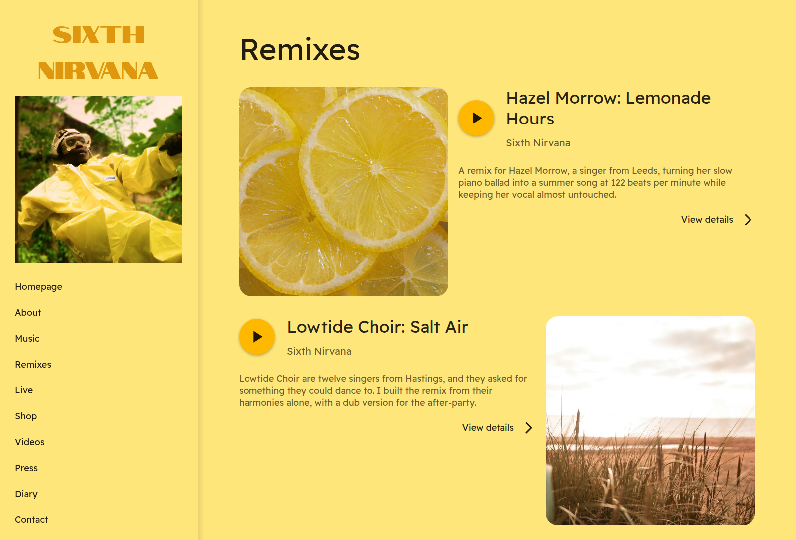
For reasons to list your services, see showing your music services on your website. If you also produce or mix, the producer website guide covers showing credits and client quotes for that work.
A marketplace profile sits in a list with other players. Your own website gives a producer one link to your reel, credits, prices and contact details, and you can put that link in every email, social profile and invoice.
Build your own musician website
Music player, store, EPK, and mailing list, all built in. Start your 30-day free trial, cancel anytime.
Skipping the terms on a friend's project. Even a favor needs the files, revisions and delivery date in writing, plus a note of your normal rate.
Playing for yourself. Record the part you were asked for first, then send any bigger idea of your own as an extra take.
Sending files that don't line up. Export every file from zero, so it lines up when the client imports it, and match the project's sample rate.
Losing track of your credits. Note every release you play on, with the artist, the date and a link, so you can add each one to your credits page.
Forgetting the union paperwork. Make sure the B4 session report reaches the employer, since it works as your invoice. The leader turns it in within 72 hours of the session, and a musician playing alone counts as the leader. If it still hasn't arrived 18 months after the session, or 6 months after the album's release if that comes first, the employer no longer has to pay you.
The AFM's main agreement sets $488.29 as a player's minimum for a basic three-hour session. Its low-budget rate and local union agreements pay less. Remote players and singers usually charge by the song, and Matt Rollings puts the range at $50 to $1,500 a song for work like his. As a freelancer, you're paid per job, so your income depends on how much work you book.
Usually, for studio work. Some sessions put a chart in front of you on the spot, so you'll need to sight-read it. Others ask you to learn a part from a demo or make one up from the producer's directions.
Yes. Remote players and singers record at home and swap files online, through a service such as WeTransfer on direct jobs or through the marketplace's own system. Clients who want union terms can hire instrumentalists under the AFM's Single Song Overdub agreement.
They can. If the AFM & SAG-AFTRA Fund covers a recording you're on, you can collect US digital performance royalties through it. You don't need to be in a union. Sessions under the AFM's main agreement can add Special Payments Fund shares, and co-writing a song earns songwriter royalties on your share.
Not to start. Some union work requires you to join, though. The AFM's main agreement gives a player who isn't a member 30 days from starting to join, where the law allows that rule. For singers, the US union is SAG-AFTRA.
Not at first. You can start with a marketplace profile and word of mouth. A website keeps everything a client checks under your own name, and it stays yours if you leave a marketplace.
Get our new guides by email.
Practical advice on promoting your music, getting gigs and selling online. You can unsubscribe at any time.