Photo by Edward Howell on Unsplash



Wedding, party, and corporate bookings pay better than almost anything else a working musician does. They also get booked in a completely different way: months ahead, for a written fee, by someone who has never hired a band before.
It's for bands, singers, and instrumentalists who want wedding, party, and corporate work, whether that means the odd Saturday booking or building a proper function act. It covers where the bookings come from, what agencies take, and what clients check before hiring a stranger for the biggest day of their year. It also covers how to get rebooked once you're in.
Wedding and corporate bookings pay a flat fee set in advance, and a steady function act can earn more from two weekends than a month of bar shows.
Agencies bring you work and take 10 to 25% of every booking, or add their fee on top of yours. Direct enquiries through your own website keep the full fee.
Clients hire on proof you are safe to book: video, reviews, a set list, and fast replies. Being their new favourite band comes second.
Start by depping for established function acts and playing weddings for people you know, then collect a review from every single one.
Build a website with your video and an enquiry form, so "wedding band" plus your town has a page to find.
Through agencies and directories at the start, and directly through their own website once reviews and video exist. Join an agency or listing site for volume, and dep for established function acts to learn the job. Then build a page with your video, song list, and an enquiry form, so couples searching your area can find and contact you.
A venue books you to pull a crowd, and pays you out of what that crowd spends. A wedding client books you to make one evening work, and pays you out of an event budget.
That difference shows up everywhere. The fee is agreed in writing before you play. Nobody asks how many people you can bring. Corporate work runs on the same shape, often midweek, which fills the nights a gigging band normally writes off. And every booking sits in a room full of engaged couples and party planners watching you do the exact job they will need soon.
The trade is the work itself. You play what the room wants, you learn requests, and you are staff for the evening as much as the entertainment. Plenty of musicians run both lives happily: original music under one name, function work under another, and the second pays for the first.
The person hiring you has probably never booked a band before and will never book one again. They spent a year planning one day, they are terrified of the parts they cannot control, and they judge you on how safe you look.
Video of a real event. One song, live, with people dancing. It answers the only question they have, which is what the room will feel like.
Reviews from other clients. A venue name and a date under each one makes them believable.
A song list. They will read all of it, and they will ask whether you can learn one more.
A fast, clear reply. Enquiries go out to several acts at once. The one who answers first, with a price and their availability, is halfway to booked.
Signs you have done it before. Public liability insurance, safety-tested gear, and a plan for arriving before the guests. Many venues, especially in the UK, ask for proof of the first two before they let you plug in.
A client comparing three acts picks the one that looks least likely to go wrong on the day. Every item on that list is buildable, whatever level you play at.
Three routes bring in function work, and established acts usually run all three at once.
Agencies find the clients, handle the contracts, and take a cut. Commission usually sits between 10 and 25%, with the function and wedding circuit clustering around 15 to 20. Some work the other way and add their fee on top of your asking price, so you get your full quote and the client pays the difference. In return you get a pipeline you did not have to build, which is why almost everyone starts here.
Directories and listing sites sit in the middle. You pay to be listed or give up a smaller cut, and clients contact you through the platform. Less admin support than an agency, more volume than going it alone.
Direct bookings come from your own website, from referrals, and from venues that recommend you. No commission, your own contract, and the client relationship stays with you. The catch is that direct enquiries only arrive once there is something to find, which is what the website section below is for.

On a four-figure wedding fee, the agency's share is hundreds per booking. Early on that is a fair price for work you could not have found. Three years in, with forty reviews and a page that ranks in your town, every direct enquiry is that same amount kept.
Get our new guides by email
Nobody hires an act with no reviews for the most photographed day of their life, so the first few come sideways.
Dep for established function acts. A dep is the stand-in when a regular member is unavailable, and function acts use them constantly. You learn the pacing, the set lists, and how the evening runs, while being paid and watched by people who book again.
Play the weddings inside your own circle. Friends, family, colleagues. Charge properly or play free for the review, but agree which it is up front.
Ask every client for a review while the glow is still on. The morning after, one message, one link. A review with a venue name and a date is the asset that unlocks the next booking.
Introduce yourself to venues and planners. Coordinators keep lists of acts that were easy to work with. Being on three venues' lists is worth more than any advert.
List with an agency once you have video. They need something to sell. One good live video from a real event is the minimum stake.
There's a wider guide to getting gigs as a musician covering the non-function side. The groundwork of building a reputation in your local scene feeds this directly too, since coordinators and venues are part of that same scene.
If you DJ, the private-event market works differently for you, and the guide to getting booked as a DJ covers that side properly.
Couples search the way the SEO guide's own example says: "wedding band in Manchester", "acoustic singer for hire in Leeds". Genre plus place, close to spending money. An agency page or a directory listing can rank for that search, and then the enquiry, and the commission, goes through them. Your own page can rank for it too.
What the page needs mirrors the checklist a client carries:
The video near the top. The live one, with dancing.
Your song list as a page, since it is the thing clients read longest.
Reviews with venue names.
Packages listed plainly: ceremony set, evening set, band plus DJ service between sets, whatever you offer. There's a guide to showcasing services on your website, and a price guide against each package saves twenty identical emails.
An enquiry form and a plain email address, answered fast.
Your town and the areas you cover, written on the page, so the genre-plus-place search has something to match. The SEO guide for musicians covers how that ranking works.
A band website builder gives you those pages ready-shaped, with the store and mailing list in the same subscription if the originals side of your life needs them.
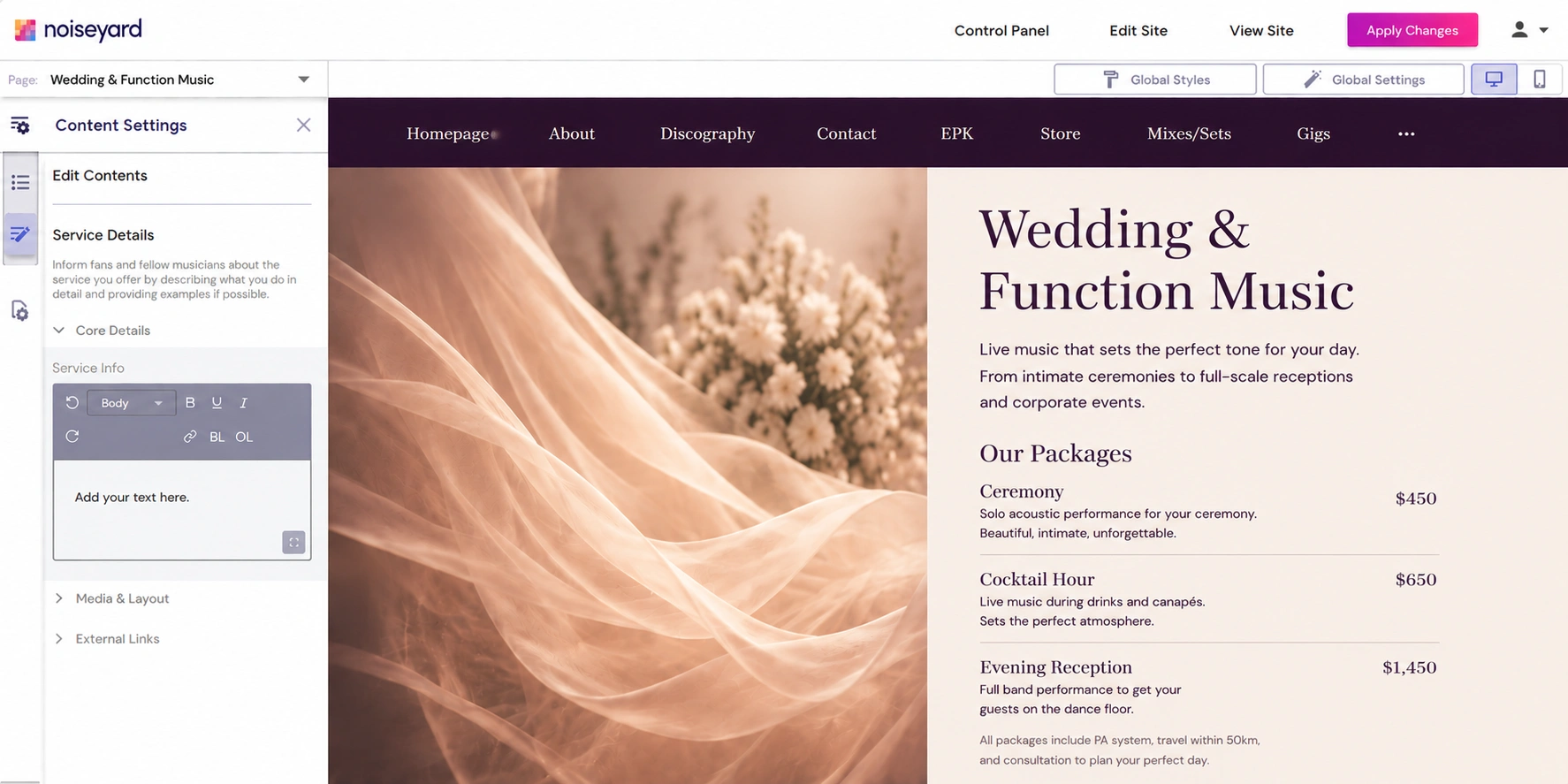
Function fees are package prices for an evening of service, so quote the whole job. That means sets, arrival time, gear, travel, and extras like a learned first dance or DJ service between sets. Quote per event, never per hour, because an hourly number invites haggling over the schedule.
The full pricing logic, including private-event fees and what to do when a client asks for a discount, is in the guide to pricing your music, merch, and shows. One function-specific rule is worth adding. Find out what acts like yours charge in your area before you quote anything. Underpricing reads as a warning sign to wedding clients, the same way it does with photographers.
Function work compounds. Every booking is an audition for the room, and the acts that fill their calendar are the ones that treat the non-musical half as the job.
Arrive before the guests, always. Load-in time goes in the contract.
Learn the first dance properly. It is three minutes of work and it is what the couple remembers.
Coordinate with the planner, the venue, and the photographer without being asked. The planner who found you easy books you for the next one.
Read the room over the set list. The best function sets are rewritten live.
Follow up the next day: a thank-you, the review ask, and a line saying you would love to be recommended.
Keep every enquiry and client email, even the ones that went nowhere. A March enquiry that booked someone else is a polite message away from being next year's booking. A mailing list of past clients and venues quietly produces referrals for years. The email list guide covers keeping that organised.

Build your own musician website
Music player, store, EPK, and mailing list, all built in. Start your 30-day free trial, cancel anytime.
Sending your original-music page to wedding clients. They need the function act: video, song list, reviews. Run a separate page or a clearly separate section.
Slow replies. Enquiries are sent to a shortlist. Answer within hours, with price and availability, and you are ahead of acts that answer in days.
No written agreement. Fee, times, sets, power needs, and what happens if the day overruns. Every time, including for friends.
Skipping insurance to save money. The venue that asks for proof will not bend on the day, and the booking dies at the door.
Underquoting to win the job. It attracts the most difficult clients and marks you as a gamble.
Going quiet after the gig. The review and the referral are earned in the follow-up week, and unclaimed ones expire.
How much do wedding bands get paid?
It varies widely by country, line-up size, and season, from a few hundred for a solo act to four figures and up for a full band on a summer Saturday. Research what acts of your size charge in your area, and quote per event with everything included.
Do I need an agency to get wedding gigs?
No, though starting with one makes sense because agencies have the client pipeline. Direct bookings through your own website grow later, as the reviews and the video build up. Established acts run both, since an agency booking is better than an empty Saturday.
Do I need insurance to play weddings?
In many places, in practice, yes. Venues commonly require public liability insurance and, in the UK, safety-tested equipment, and they ask for the paperwork before you set up. Musician unions and associations usually offer it cheaply with membership.
Can a solo musician get wedding work?
Yes, and the ceremony and drinks-reception slots are largely solo and duo territory: acoustic sets, piano, strings. Solo acts also price under full bands, which fits the budgets full bands turn down. The same rules apply, with video, reviews, and a song list doing the selling.
Do wedding bands need a website?
You can start from an agency profile alone. The searches that pay full fee, though, your act's name or "wedding band" plus your town, need a page you own to point at. It holds the video, the reviews, the song list, and the enquiry form in one place that no platform controls.
Function work rewards the unglamorous things: replying fast, showing up early, learning the song that matters, and asking for the review. The musicianship gets you considered, and the reliability gets you booked.
Start sideways through deps and your own circle, let agencies fill the calendar while your reviews build, and put everything a client checks on a page of your own. Then answer every enquiry the day it arrives, because the whole business runs on that habit.
Get our new guides by email.
Practical advice on promoting your music, getting gigs and selling online. You can unsubscribe at any time.